

Reviewed · STOCKHOLM TOURS
Stockholm Must Sees
The most striking part of this Stockholm tour comes at the end: the Vasa Museum’s enormous 17th-century warship, preserved about 98 percent intact after sinking on its maiden voyage in 1628. Before you reach the ship, you walk through Gamla Stan, where medieval lanes, royal power, churches, and old legends make Stockholm’s past easy to picture.
I like the smart pairing of Gamla Stan and the Vasa Museum, two essential sights that sit in different parts of the city. I also like that the ferry ride is built into the route, giving you a useful taste of Stockholm’s waterways instead of sending you from one sight to the next by taxi or coach.
The tradeoff is pace. Three hours is enough for an introduction, not a slow, detailed examination of every stop. Much of the walk is over cobblestones, and one past experience was disappointing because the guide could not be heard clearly, so guide quality and group positioning matter.
In This Review
- Key points to know before booking
- Why this makes a strong first morning in Stockholm
- Stortorget begins the story in Gamla Stan
- Prästgatan and the Old Town’s darker corners
- Royal Palace: a working seat of Swedish monarchy
- Storkyrkan and the original St. George sculpture
- Iron Boy and Stockholm’s smallest statue
- Mårten Trotzigs gränd, with no exaggerated claim
- The ferry from Skeppsbron to Djurgården
- The Vasa Museum and a ship that should have stayed afloat
- What the three-hour format really gives you
- Price, group size, and practical value
- Walking conditions and what to wear
- Who will get the most from this tour
- Should you book Stockholm Must Sees?
- FAQ
- How long does Stockholm Must Sees last?
- Where does the tour begin?
- Where does the tour end?
- Is Vasa Museum admission included?
- Is the ferry ticket included?
- How much time is spent at the Vasa Museum?
- How many people can join the tour?
- Is the tour suitable for someone with limited mobility?
- What happens if the weather is poor?
- Can I cancel for a full refund?
Key points to know before booking
- Two major sights in three hours: You cover central Gamla Stan and the Vasa Museum in one morning.
- The ferry is part of the experience: A public boat carries you from Skeppsbron to Djurgården, with a short ride and photo opportunities along the way.
- Vasa Museum admission is included: You enter with the group and receive a guided introduction to the ship before exploring on your own.
- The walk focuses on small details: Mårten Trotzigs gränd, the tiny Iron Boy statue, and the old Hell’s Alley add character beyond the standard palace stop.
- Expect cobblestones and a moderate physical effort: Comfortable shoes and weather-ready clothing are important.
- The tour ends at the museum: You can stay inside afterward or continue to nearby museums, but you arrange your own return.
Why this makes a strong first morning in Stockholm
This is an orientation tour, and that is its greatest use. If you are new to Stockholm, the route gives you a quick sense of how the city fits together: Gamla Stan occupies the historic center, water separates the islands, and Djurgården gathers several major museums in one easy-to-reach area.
The start time is 10:00 a.m. at Stortorget, the oldest square in Stockholm. That timing works well for a first full day because you can begin after breakfast and finish around lunchtime, leaving the rest of the day for the Vasa Museum, another Djurgården museum, or a return to the Old Town.
The tour is limited to a maximum of 16 people. That is small enough for a personal feel in narrow lanes, though you should still stay close to the guide in busy areas and position yourself where you can hear. One poor experience involved a guide who spoke too softly to a group, while the strongest experiences praised guides such as Kevin, Ebba, Katrine, Joel, and Marita for clear explanations, good pacing, and a friendly manner.
That contrast gives you a useful point to consider. The route is excellent, but it relies on the guide to bring the history to life and keep everyone together during the ferry transfer.
Other Stockholm days worth booking alongside this:
- Stockholm: City Archipelago Sightseeing Cruise with Guide
★ 4.3 · 10,798 reviews - Stockholm: Skansen Open-Air Museum Admission Ticket
★ 4.5 · 3,427 reviews - Stockholm: Archipelago Boat Tour
★ 4.4 · 3,110 reviews
Stortorget begins the story in Gamla Stan
Stortorget is more than a convenient meeting point. This square has long been the heart of Gamla Stan, and its old buildings give you an immediate sense of Stockholm’s age and scale.
The Nobel Museum occupies the square today, linking the medieval center with one of Sweden’s best-known modern institutions. The tour does not include admission to the museum, but you will have a chance to note it for a later visit.
Your guide uses Stortorget to explain Stockholm’s medieval beginnings and how the Old Town developed around narrow streets and waterways. I find this kind of opening useful because it gives the rest of the walk a framework. Instead of seeing a collection of attractive buildings, you begin to understand why the streets are so tight and why the city grew across several islands.
You spend about 15 minutes here. That is enough for orientation and photographs, but not enough for an extended look at the Nobel Museum or the surrounding architecture.
Prästgatan and the Old Town’s darker corners
From the square, the route moves into Prästgatan, or Priest Street. The northern end once carried the grim name Helvetsgränd, translated as Hell’s Alley, because of an old belief that land near the church had been a desecrated burial place.
This is the sort of small story that can disappear if you explore without a guide. The lane is not a major monument, but it helps you read Gamla Stan as a lived-in medieval quarter rather than a polished historic district.
The streets were built for people, horses, and handcarts, not cars. You will pass through narrow passages where the route itself becomes part of the lesson. The walk is visually rewarding, but it is not the place for rolling luggage or shoes with poor grip.
Royal Palace: a working seat of Swedish monarchy

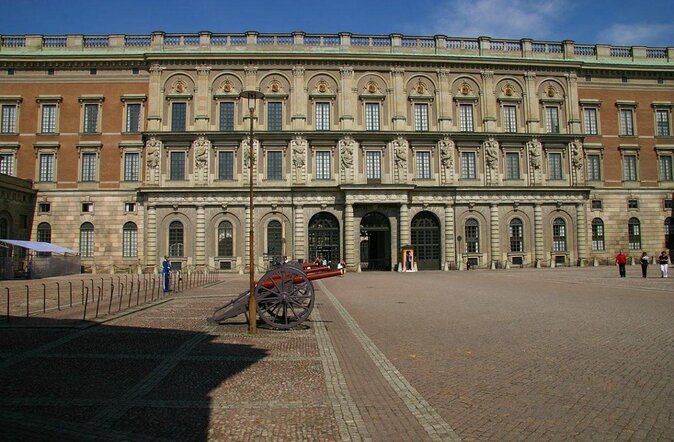
The Royal Palace is one of the tour’s most recognizable stops. It is the King’s official residence and a working place for the King and Queen, with important royal duties carried out there.
The outside visit gives you context without turning the morning into a palace tour. You learn why the building still matters to Sweden’s monarchy and how it functions as more than a grand historic façade.
The stop lasts about 10 minutes and admission is not included. If you want to see the palace interiors, royal apartments, or other paid areas, you will need to return separately. That is not a flaw in this tour, but it is important to understand the difference between seeing the palace and touring it.
For a first visit, I like the brief approach. You get the location and the story, then save a longer palace visit for a day when you can give it your full attention.
Same city, a completely different kind of day:
- Stockholm: Highlights Boat Tour
★ 4.3 · 2,542 reviews - Stockholm Pass: Save up to 50% – Includes Vasa Museum Ticket
★ 4.1 · 2,392 reviews - Stockholm: Ghost Walk and Historical Tour
★ 4.7 · 2,206 reviews - Walking Tour of Stockholm Old Town
★ 5.0 · 1,175 reviews
Storkyrkan and the original St. George sculpture
Storkyrkan, also called Stockholm Cathedral or the Coronation Church, is one of the Old Town’s oldest buildings. It has hosted royal weddings, including the marriage of King Carl XVI Gustaf and Queen Silvia, followed by the wedding of Crown Princess Victoria and Prince Daniel in 2010.
The cathedral’s most famous artwork is the wooden original of St. George and the Dragon. The tour also points out a bronze copy nearby, helping you understand the difference between the two versions.
The image carries a political meaning. St. George represents Sweden, while the dragon symbolizes Denmark in a story tied to conflict in the late 15th century. You are not simply looking at a knight and monster. You are seeing national history expressed through a religious sculpture.
The cathedral stop is listed at about 10 minutes. The experience may include viewing the interior and the original sculpture, but you should not expect a long, quiet church visit. If religious art or historic interiors are a priority, plan to return independently.
Iron Boy and Stockholm’s smallest statue

Järnpojke, or Iron Boy, is a tiny statue also known as the Boy Looking at the Moon. It is described as Sweden’s smallest statue, and its size makes it an amusing contrast to the palace and cathedral.
This stop is brief, about 10 minutes, but it adds a human touch to the route. You get a small piece of local character rather than another grand civic monument. Your guide can point it out easily, while finding it on your own may be less certain.
I like stops like this because they give you a detail to watch for during the rest of your time in Stockholm. It also breaks up the heavier material about monarchy, war, and religion.
Mårten Trotzigs gränd, with no exaggerated claim

Mårten Trotzigs gränd is Stockholm’s narrowest alley, measuring only about 90 centimeters at its tightest point. It is a natural photo stop, but it is also a reminder of how tightly packed medieval Gamla Stan once was.
Some guidebooks call it the narrowest alley in Europe. Your guide gives you the more accurate version: that claim is not true, since an alley in Prague measures about 60 centimeters. That small correction is a good sign of the tour’s tone. The point is not to repeat the biggest claim, but to tell the story accurately.
The alley can feel cramped, especially when several groups arrive at once. Move carefully on the stone steps and keep your belongings close. The stop is more about atmosphere and perspective than a major sightseeing payoff, but it is one of the Old Town’s memorable details.
The ferry from Skeppsbron to Djurgården

At Skeppsbron 26, the walking portion gives way to public transport. You board a public ferry for roughly 20 minutes to Djurgården, the island where the Vasa Museum is located.
This is a practical part of the route, but it is also one of the most enjoyable transitions. Stockholm is built around water, and the ferry lets you see the city from a different angle without adding a special cruise to your budget.
The included public transport ticket keeps the transfer simple. You do not need to arrange a separate boat ride, and the ferry serves as both transportation and sightseeing. Have your camera ready, but remember that weather and boat conditions can affect how comfortable the ride feels.
The ferry is public transport, not a private sightseeing cruise. That means the experience is efficient rather than staged. You are using Stockholm as residents do, which fits the tour’s practical character.
The Vasa Museum and a ship that should have stayed afloat
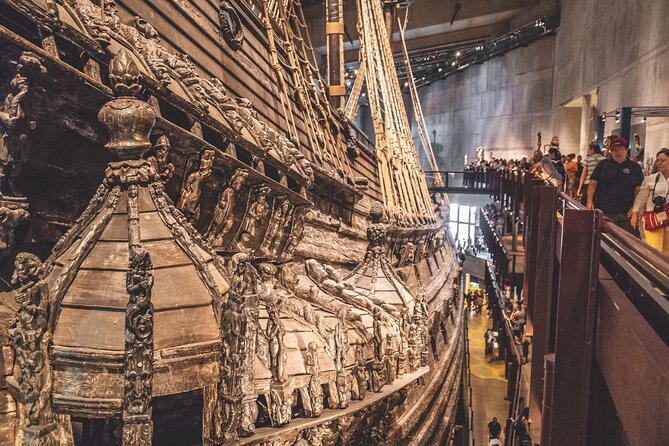
The Vasa Museum is the reason many people choose this tour. Inside is the Vasa, a heavily ornamented Swedish warship built in the 17th century. It sank in Stockholm harbor during its maiden voyage in 1628, with people watching from the shore.
The ship remained underwater for centuries before being recovered and restored. Today, it is about 98 percent intact, making it the only preserved ship from the 1600s of its kind.
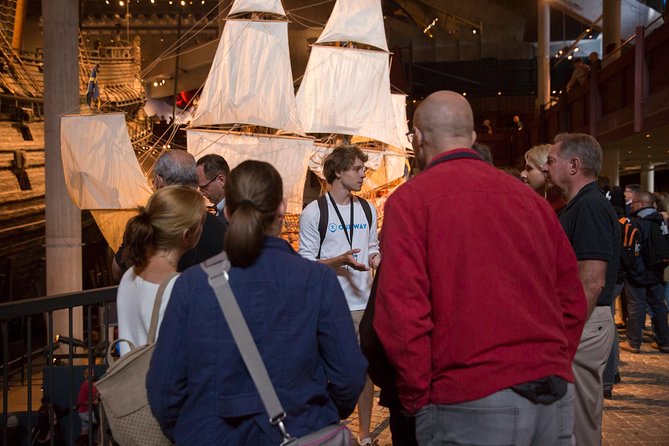
You receive included admission and a guided visit lasting about an hour. The guide explains the ship’s story, the disaster, and the work involved in preserving such a large wooden vessel. This introduction matters because the museum is extensive, and the Vasa can be overwhelming when you first enter.
After the guided portion, the tour ends. You can continue exploring the museum on your own, which is a smart arrangement. The guide gives you the basic story and helps you understand what you are seeing, while you decide how much more time to spend with the displays.
The Vasa is not just impressive because it is large. The ship connects engineering, royal ambition, naval power, decoration, archaeology, and human error in one object. You can look closely at carved details, then step back and grasp the scale of the vessel. It is the kind of museum experience that works for both history enthusiasts and people who usually lose interest in museums.
The included entry also saves you from arranging a separate ticket. The tour description says the group skips the line, although you should still follow the guide’s instructions and allow for normal museum procedures.
What the three-hour format really gives you
The advertised duration is about three hours. The listed stops add up to roughly two hours and 25 minutes, leaving time for walking between locations, gathering the group, boarding the ferry, and entering the museum.
That schedule is brisk. At the Royal Palace, cathedral, Iron Boy, and narrow alley, you get a focused explanation rather than an extended visit. The Vasa Museum receives the longest single stop, about one hour, because it is the tour’s main indoor attraction.
One past assessment described the Old Town portion as a fast pass by, while the Vasa Museum received strong praise. I think that is a fair way to set expectations. Book this for orientation and key sights, not for a leisurely architectural study or a full palace and cathedral visit.
The advantage is efficiency. You see the essential shape of Stockholm in one morning and finish beside several other museums. The disadvantage is that you may want more time at places that catch your interest.
Price, group size, and practical value
The price is $113.48 per person. That is not a budget walking tour, but the cost includes a professional guide, the Vasa Museum entrance fee, and the public transport ticket for the ferry transfer.
The real value depends on how you use the tour. If you already plan to visit the Vasa Museum and are comfortable finding your own way around Gamla Stan, you could prefer independent sightseeing. If you want the museum entry, route planning, historical explanations, and ferry transfer handled together, the package is easier to justify.
I especially see value for a first morning in Stockholm. Several people used the tour to identify places to revisit for food, museums, and further exploring. That is a practical benefit: a good guide can help you decide where to spend the rest of your stay.
The tour is usually booked well ahead, with an average booking time of 37 days in advance. That suggests you should reserve early if your Stockholm dates are fixed, though availability can change.
Walking conditions and what to wear
You need a moderate level of physical fitness. The route includes a substantial walk through Gamla Stan, narrow streets, cobblestones, and the ferry transfer.
Wear comfortable shoes with good support. Cobblestones can be tiring, especially if you are not used to walking on uneven surfaces. The experience operates in all weather, so dress for the forecast and bring suitable protection from rain, wind, or cold.
The tour is not described as fully accessible. One guide was specifically praised for being kind and attentive to a person whose husband walked with a cane, but that individual care should not be treated as a guarantee about the entire route. If mobility is a serious concern, contact the provider before booking and ask about the exact conditions on your date.
Stay close to the group around ferry boarding areas and crowded lanes. Clear communication is especially important here, since one weak experience involved a guide who could not be heard by everyone.
Who will get the most from this tour
I would choose this experience if you have only a short stay in Stockholm, are visiting for the first time, or want a guided framework before exploring independently.
It suits adults who enjoy history, architecture, city stories, and museums. The pace is also useful for anyone who wants to cover two major sights without spending half a day organizing tickets and transport.
It is less suitable if you prefer long stops, quiet photography, or complete freedom to set your own pace. Families with very young children may find the historical walking portion demanding, though the Vasa ship itself gives the tour a strong visual payoff.
Guide style can shape the experience. Kevin was praised for being engaging, clear, entertaining, and good at answering questions. Ebba was described as sharing personal knowledge of Sweden, while Katrine was noted for her calm pace and clear speaking. Joel and Marita also received praise for making the history easy to follow. These details point to the kind of guide-led experience you should expect, while also explaining why standing near the guide matters.
Should you book Stockholm Must Sees?
Book it if you want an efficient introduction to Stockholm that combines Gamla Stan’s small historic details with the city’s most unforgettable museum. The ferry, included admission, and guided Vasa visit make the route easy to manage, and finishing at Djurgården lets you continue with nearby museums afterward.
Skip it if you want a slow Old Town walk or plan to spend several hours inside the Vasa Museum. In that case, explore Gamla Stan independently and give the museum a separate block of time.
For most first-time visitors with limited time, I think the tour offers solid value. Just expect a brisk walk, wear proper shoes, and treat the Old Town portion as an overview that points you toward places worth revisiting.
FAQ
How long does Stockholm Must Sees last?
The experience lasts about three hours, including the Gamla Stan walking tour, ferry transfer, and guided visit to the Vasa Museum.
Where does the tour begin?
The tour begins at Stortorget 2 in Stockholm’s Old Town. The listed start time is 10:00 a.m.
Where does the tour end?
The tour ends at the Vasa Museum on Galärvarvsvägen 14, Djurgården. You can continue exploring the museum or nearby museums, then make your own way back by walking or public transport.
Is Vasa Museum admission included?
Yes. The Vasa Museum entrance fee is included, and the group enters with the guide.
Is the ferry ticket included?
Yes. A public transport ticket for the trip to the Vasa Museum is included.
How much time is spent at the Vasa Museum?
The guided visit at the Vasa Museum lasts about one hour. Afterward, you can continue exploring the museum on your own.
How many people can join the tour?
The tour has a maximum of 16 participants.
Is the tour suitable for someone with limited mobility?
The tour requires a moderate level of physical fitness, and much of the route uses cobblestone streets. The supplied information does not guarantee full accessibility, so contact OURWAY Tours before booking if you have specific mobility needs.
What happens if the weather is poor?
The tour operates in all weather conditions. Dress comfortably and appropriately for the forecast, with particular attention to footwear and rain protection.
Can I cancel for a full refund?
Yes. You can cancel at least 24 hours before the local start time for a full refund. Cancellations or changes made less than 24 hours before the start time are not accepted for a refund.
Just added around Stockholm
- World War II Stockholm Old Town Walking Tour and Army Museum★ 4.6 · 4 reviews
- Stockholm: Archipelago Guided Boat & Walking Tour of Vaxholm★ 3.1 · 23 reviews
- Stockholm: Underground Metro Art Ride with a Local Guide★ 4.6 · 39 reviews
- Vaxholm & Stockholm Archipelago: Guided Excursion, Day Trip★ 4.8 · 41 reviews
- Wolf and Wildlife Tracking in Sweden★ 5.0 · 9 reviews
- Scandinavian Art, Architecture and Design Tour in Stockholm★ 4.5 · 11 reviews
- Private Tour: Swedish History Day Trip to World Heritage Candidate Markim-Orkesta from Stockholm★ 5.0 · 8 reviews
- Walking Tour of Stockholm’s City Center★ 4.5 · 26 reviews
Stockholm Tours, compared.

City Archipelago Sightseeing Cruise with Guide
Read our review →



Stockholm Pass: Save up to 50% – Includes Vasa Museum Ticket
Read our review →

The Original Stockholm Ghost Walk and Historical Tour – Gamla Stan
Read our review →Browse the lists this tour appears in