
Reviewed · WALKING TOURS
Beautiful Stockholm Small Group Walking Tour
Stockholm’s story comes into focus as you walk from grand royal buildings into the narrow lanes of Gamla stan. In less than two hours, you move from the Royal Swedish Opera and Parliament to palace courtyards, Nobel history, and the square where Stockholm’s 16th-century bloodbath took place.
I like the small group limit of 10, which gives the guide room to explain details and answer questions. I also like the clear mix of Swedish politics, royal life, architecture, and Old Town stories rather than a tour that focuses on only one subject. The main drawback is the price: at $106.42 per person, this is a costly walking tour for 1 hour and 45 minutes, and it does not include admission to museums or major palace interiors.
In This Review
- Key points to know before you book
- Starting at the Royal Swedish Opera
- Parliament, from four estates to one chamber
- Crossing Riksbron for Stockholm views
- Lejonbacken and the royal power of Stockholm
- Palace courtyards and the Bernadotte dynasty
- Stortorget and the darkest square in Gamla stan
- Walking the medieval lanes of Gamla stan
- What $106.42 buys you
- Timing, meeting point, and the final stop
- Who will get the most from this walk
- Should you book the Beautiful Stockholm Small Group Walking Tour?
- FAQ
- How long does the Stockholm walking tour last?
- Where does the tour begin?
- Where does the tour end?
- Is the tour offered in English?
- How many people can join the tour?
- Does the tour include admission to the Royal Palace or museums?
- What fitness level is needed?
Key points to know before you book
- Royal Stockholm in a compact walk: Begin near Gustav Adolf’s Square and see the Opera, Royal Palace, Parliament, and royal monuments.
- A strong Old Town finish: The final section covers Stortorget, the Nobel Prize Museum, medieval streets, and the waterfront at Skeppsbron.
- Small group setting: A maximum of 10 people should make it easier to hear the guide and ask questions.
- History with visual detail: The guide explains architecture and uses visual aids, which helps make the buildings easier to understand.
- No museum admissions included: The listed stops are viewed from outside, with a short visit to the Palace Chapel.
- Convenient ending: The walk finishes at the south end of Kungsträdgården, near transport toward Djurgården’s museums.
Starting at the Royal Swedish Opera
You meet at Gustav Adolfs torg, a central square named for King Gustav II Adolf. The opening stop is the Royal Swedish Opera, where the guide introduces Stockholm and Sweden before the group begins crossing the city’s royal and political center.
This is a useful start because the surrounding buildings explain how monarchy, government, culture, and foreign affairs have long shared the same small part of Stockholm. The Royal Palace is nearby, built in the early 18th century in the Baroque style. Across the square, the building now used by the Ministry of Foreign Affairs was once the palace of the heir presumptive.
The Opera has a story tied to King Gustav III and Giuseppe Verdi’s opera Un ballo in maschera, known in English as The Masked Ball. The connection gives the building more character than a quick exterior photograph. You are not simply looking at a grand theater. You are hearing about royal power, public performance, and the political drama surrounding Gustav III.
You spend about 15 minutes here, with no admission charge. I would use this opening to get your bearings and listen closely to the guide’s explanation of the buildings around the square. Since the tour is short, the early context helps you understand the stops that follow.
A few more Stockholm trips to weigh up
- Stockholm: Ghost Walk and Historical Tour
★ 4.7 · 2,206 reviews - Walking Tour of Stockholm Old Town
★ 5.0 · 1,175 reviews - The Original Stockholm Ghost Walk and Historical Tour – Gamla Stan
★ 4.5 · 1,165 reviews
Parliament, from four estates to one chamber
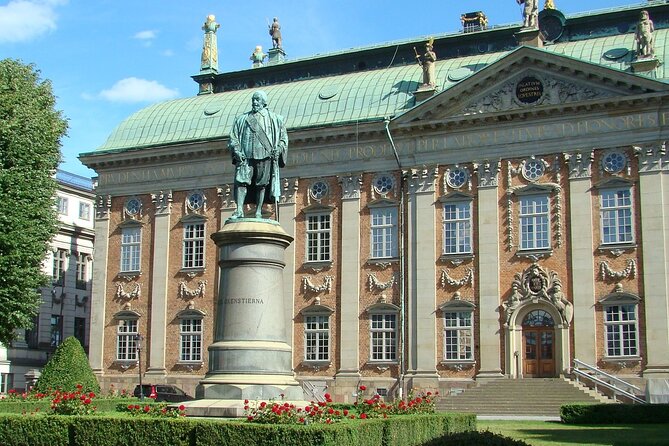
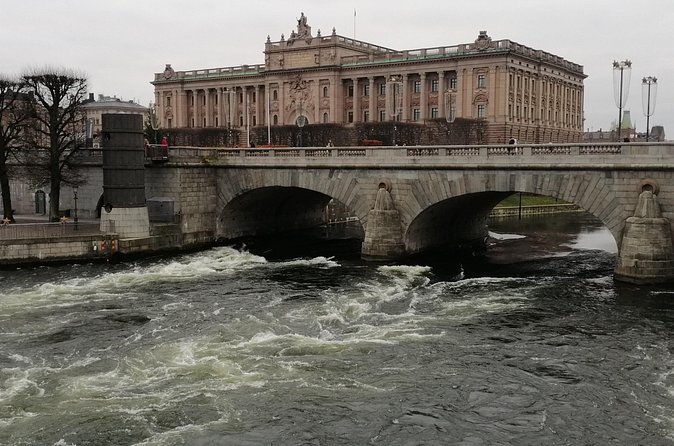
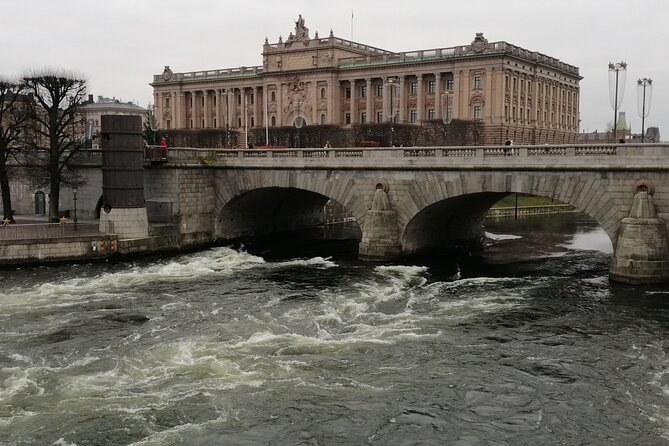
The next stop is Riksdagshuset, Sweden’s Parliament Building. Its Neo-Renaissance design and Neo-Baroque facade make it one of the more formal buildings on the route, but the political story is the real reason to pause here.
The guide traces Swedish government from the old Riksdag of the Estates. Nobility, clergy, burghers, and peasants once met separately before presenting their views to the king. This system lasted until 1866, when Sweden introduced a two-chamber parliament.
That change did not immediately create equal voting rights. General suffrage arrived only after a long political struggle, and the first elections under that system took place in 1921. In 1975, the two chambers merged into the single parliament Sweden has today. The same constitutional change confirmed that the king’s role was representative rather than executive.
You have about 10 minutes here. That is enough for a concise explanation and an exterior look, but not for a full study of Swedish political development. If government and social reform interest you, this will likely be one of the most useful parts of the walk. If you prefer architecture and street scenes, it is a short pause before the more visual bridge and palace sections.
Crossing Riksbron for Stockholm views
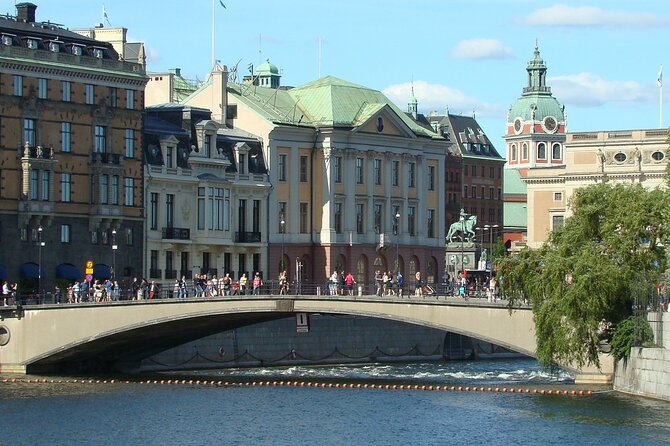
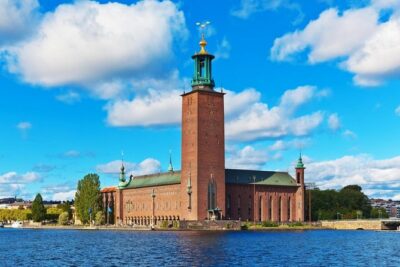
At Riksbron, the walk opens up. From the bridge, you can look toward Riddarholmen, or Knights Island, and see several important civic buildings at once. The Prime Minister’s residence, Government building, House of Nobility, and Stockholm City Hall all enter the view.
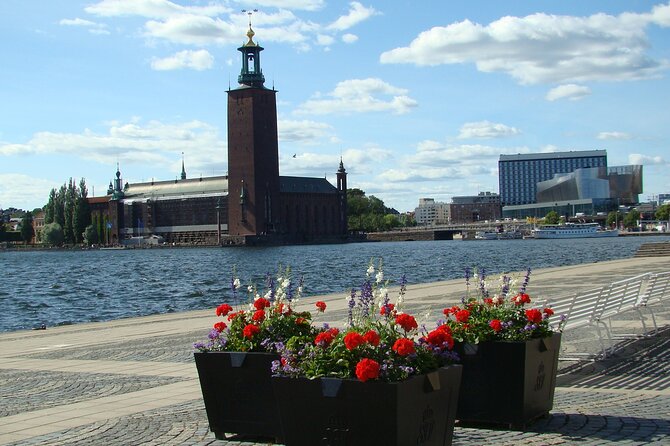
City Hall is especially familiar because it hosts the annual Nobel Prize banquet. The bridge is a good place to connect Stockholm’s political life with its ceremonial life. The route does not take you inside City Hall, but the view gives you a useful sense of how the city’s islands and institutions fit together.
The stop lasts about 15 minutes. Bring a coat or scarf if the weather is unsettled. One person specifically noted a very windy day, and bridges can make a cool Stockholm day feel sharper. The open view is worthwhile, but you will want comfortable clothing rather than relying on the shelter of the Old Town’s narrow lanes.
Lejonbacken and the royal power of Stockholm
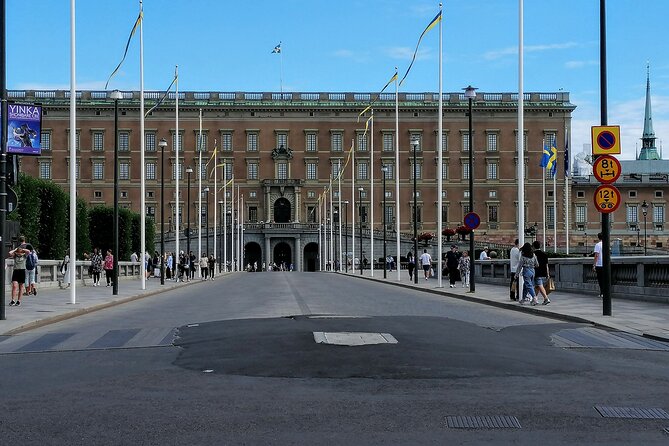
Lejonbacken sits on the north side of the Royal Palace and is one of the route’s best photo locations. The broad approach gives you a sense of the palace’s scale, while the name refers to the lion sculptures along the ramps.
From here, the guide places Sweden’s royal buildings in the context of the country’s period as a major Northern European power during the 17th and 18th centuries. You also see the Royal Garden and the statue of Karl XII, remembered as the last of Sweden’s warrior kings.
The view reaches toward Stockholm’s Financial District, built around the turn of the 20th century. That contrast is part of the appeal: old royal power on one side, modern commerce on the other. The Grand Hotel is also visible. It is Stockholm’s most prestigious hotel and the place where Nobel laureates stay during the prize ceremonies.
You spend roughly 15 minutes here. I would expect exterior commentary and photo time, not a palace tour. That distinction matters because anyone hoping to explore the Royal Palace rooms will need a separate visit.
Same city, a completely different kind of day:
- Stockholm: City Archipelago Sightseeing Cruise with Guide
★ 4.3 · 10,798 reviews - Stockholm: Skansen Open-Air Museum Admission Ticket
★ 4.5 · 3,427 reviews - Stockholm: Archipelago Boat Tour
★ 4.4 · 3,110 reviews - Stockholm: Highlights Boat Tour
★ 4.3 · 2,542 reviews
Palace courtyards and the Bernadotte dynasty
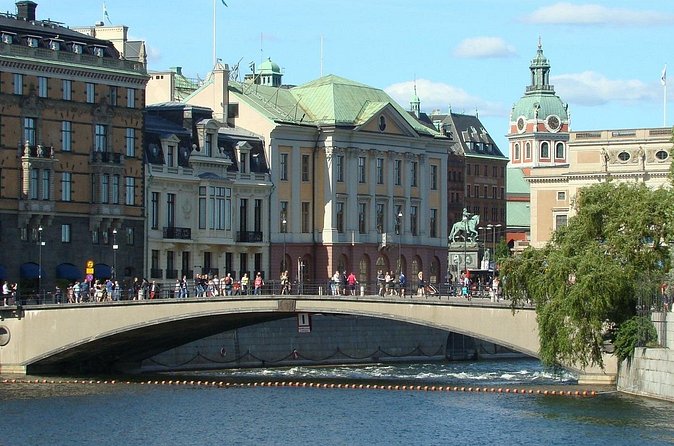
The route continues along Slottsbacken, past the inner courtyard of the Royal Palace. The tour includes a short visit to the Palace Chapel, where royal children are baptized. This is the closest the walk comes to a royal interior, and it adds a quiet change of pace after the broad views at Lejonbacken.
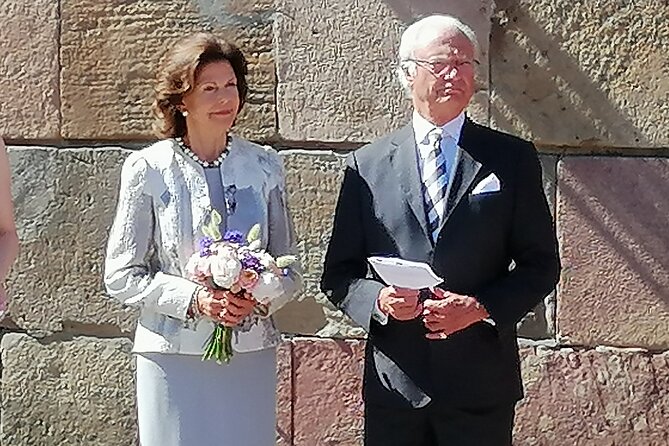
Outside, you see a statue of Carl XIV Johan. His path to the Swedish throne is unusual. He began as a French soldier in Napoleon’s army and was later adopted into the Swedish royal family. He became the first ruler of the Bernadotte dynasty, which still occupies the Swedish throne.
The story is also a reminder that Sweden’s modern identity was shaped by practical choices, not only battlefield victories. Carl XIV Johan helped direct the country toward diplomacy, infrastructure, and education. Sweden celebrated 200 years of peace in 2014, a fact that gives this section a clear link between royal policy and the modern state.
The guide also connects industrial growth, natural resources, and Swedish inventions with the development of the welfare state. You will not get a full economic history in 10 minutes, but the explanation gives useful background for the rest of your stay.
Stortorget and the darkest square in Gamla stan
Stortorget is the central square of Stockholm’s Old Town and one of the city’s most photographed places. Its colorful buildings reflect several periods, including Scandinavian Renaissance architecture from the 17th century and Classicism from the 18th century.
The square is attractive, but its history is grim. In November 1520, around 100 noblemen and priests were beheaded here during the Stockholm Bloodbath. The executions were ordered by the Danish king Christian II, who became known in Sweden as Christian the Tyrant.
This is an important stop because it keeps Gamla stan from becoming just a pretty collection of old facades. The square tells you about Denmark’s control, Swedish resistance, and the political tensions that helped shape the country.
The Nobel Prize Museum is also located here. The Swedish Royal Academies and other committees select Nobel winners in science, literature, and other fields. The tour does not include museum entry, but the guide can place the institution in the setting of the old square.
You spend about 15 minutes at Stortorget. It is a busy photo stop, so stay close to the group and listen for the historical explanation before taking pictures. The square is compact, and the guide’s story helps you see past the postcard view.
Walking the medieval lanes of Gamla stan
The final Old Town section follows Köpmangatan, or Merchants Street. Written records mention this street as early as 1350, making it one of the route’s strongest links to medieval Stockholm.
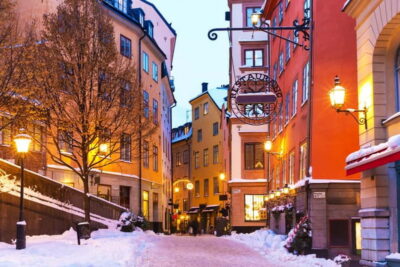
The guide leads you through narrow alleyways where the city feels far removed from the formal squares and government buildings. The lanes are the kind of place where a local guide’s sense of direction and storytelling matter. You get a better feel for how the medieval town was arranged, rather than simply walking along a broad route between landmarks.
The path continues along Österlånggatan and down to Skeppsbron, the waterfront road where ships have loaded cargo since the 17th century. This creates a logical ending. You have seen Stockholm as a royal capital, political center, and trading port, all within a relatively short walk.
The Old Town section lasts about 20 minutes. Parts of Gamla stan can be uneven or crowded, so sturdy shoes are sensible. The stated physical requirement is moderate fitness, which fits the route: you are walking continuously, but this is not a strenuous hike.
What $106.42 buys you
At $106.42 per person, this is not a budget introduction to Stockholm. The ticket covers the guided walk, but the listed stops are free exterior viewpoints, and there is no broad museum admission included.
The value depends on what you want from a guide. If you only need directions between the Royal Palace, Stortorget, and Skeppsbron, you can visit those places on your own. If you want the buildings connected through Swedish politics, royal succession, military power, architecture, and Nobel history, the guide provides the main benefit.
The maximum group size of 10 also matters. A small group should be easier to manage on narrow Old Town streets, and you have a better chance of hearing the guide clearly. One review praised the guide’s friendly manner and informative approach, while another noted the use of visual aids to explain architecture. Those are useful strengths for a tour built around exterior buildings, where small design details can otherwise be easy to miss.
I would consider the tour better value for a first visit, a short stay, or a cruise stop when you need a fast orientation. It is harder to justify if you already know Stockholm well or plan to spend the same amount on several museum admissions.
Timing, meeting point, and the final stop
The walk begins at Gustav Adolfs torg and ends at the Karl XII statue at the southern end of Kungsträdgården. The ending is practical rather than remote. Kungsträdgården is a central park, and you can continue through the city or take the tram toward Djurgården.
Djurgården is Stockholm’s museum island, with the Vasa Museum, Viking Museum, ABBA Museum, and Skansen. The walking tour does not include those attractions, but its ending makes it possible to continue your sightseeing there afterward.
The experience is offered in English and uses a mobile ticket. Confirmation arrives when you book, and the route is near public transportation. Since the tour is usually booked about 11 days ahead, I would reserve early if your Stockholm dates are fixed, especially if you want the small group format.
The walk lasts approximately 1 hour and 45 minutes. The listed stop times add up to roughly 100 minutes, so the remaining time allows for movement between locations and short explanations along the way. Plan for outdoor conditions, changing weather, and enough walking to meet the moderate fitness requirement.
Free cancellation is available if you cancel at least 24 hours before the start time. Changes or cancellations made later are not accepted for a refund.
Who will get the most from this walk
I would recommend this tour to you if you want a clear first look at Stockholm without spending half a day inside one museum. It suits anyone who likes architecture but wants the political and personal stories behind the buildings.
It is also a good fit for a short visit. The route covers several central sights efficiently, and the ending near Kungsträdgården lets you continue to Djurgården or explore more of the city on foot.
Families and older visitors should consider the continuous walking and Old Town lanes. The group is small, but the tour is still conducted outdoors for most of its length. A moderate fitness level is expected.
I would hesitate if your main goal is Viking history. The tour may put Sweden’s earlier past into context, but its main focus is Stockholm from medieval times onward, with particular attention to royal, political, and architectural stories. I would also hesitate if you want extended indoor visits, since the Palace Chapel is the only brief interior stop described.
Should you book the Beautiful Stockholm Small Group Walking Tour?
Book it if you value a well-organized introduction, a small group, and a guide who can explain architecture with visual aids and connect the city’s landmarks to Swedish history. The route gives you a useful first framework for Stockholm, from royal power and parliamentary reform to the Bloodbath, Nobel traditions, medieval commerce, and the modern waterfront.
Skip it if $106.42 feels too high for a short walk with few included admissions, or if you prefer to explore at your own pace. For a first-time visitor with limited time, though, the combination of central sights and a maximum of 10 people makes this a practical, focused way to get oriented.
FAQ
How long does the Stockholm walking tour last?
The tour lasts approximately 1 hour and 45 minutes.
Where does the tour begin?
The meeting point is Gustav Adolfs torg, 111 52 Stockholm, Sweden.
Where does the tour end?
The walk ends at the Karl XII statue at the southern end of Kungsträdgården.
Is the tour offered in English?
Yes. The experience is offered in English.
How many people can join the tour?
The group has a maximum of 10 people.
Does the tour include admission to the Royal Palace or museums?
The listed stops have no admission charge, and the tour includes a short visit to the Palace Chapel. Admission to the Royal Palace, Nobel Prize Museum, City Hall, and other museums is not included.
What fitness level is needed?
A moderate level of physical fitness is recommended. You should be ready for continuous walking through central Stockholm, including narrow Old Town streets.
Just added around Stockholm
- World War II Stockholm Old Town Walking Tour and Army Museum★ 4.6 · 4 reviews
- Stockholm: Archipelago Guided Boat & Walking Tour of Vaxholm★ 3.1 · 23 reviews
- Stockholm: Underground Metro Art Ride with a Local Guide★ 4.6 · 39 reviews
- Vaxholm & Stockholm Archipelago: Guided Excursion, Day Trip★ 4.8 · 41 reviews
- Wolf and Wildlife Tracking in Sweden★ 5.0 · 9 reviews
- Scandinavian Art, Architecture and Design Tour in Stockholm★ 4.5 · 11 reviews
- Walking Tour of Stockholm’s City Center★ 4.5 · 26 reviews
- Private Tour: Swedish History Day Trip to World Heritage Candidate Markim-Orkesta from Stockholm★ 5.0 · 8 reviews
Walking Tours, compared.
The Original Stockholm Ghost Walk and Historical Tour – Gamla Stan
Read our review →
Best of Stockholm Walking Tour-3 Hours, Small Group max 10 people
Read our review →
Old Town Guided Walking Tour (English / Deutsch)
Read our review →Browse the lists this tour appears in