
Reviewed · WALKING TOURS
Classic Stockholm Small Group Walking Tour | 3 Hours
Stockholm’s story unfolds in layers on this walk, from the narrow 36-step Mårten Trotzigs Gränd to the Royal Palace, Parliament, and the Nobel Prize Museum. I like the way the route connects medieval Gamla Stan with modern Swedish government, rather than treating the Old Town as a pretty island frozen in time. I also like that guides such as Kenneth and Rachel add local advice, personal stories, and practical help beyond the formal route.
The main consideration is pace and footing. Three hours covers a lot of ground, including cobblestones, steps, and several islands. You will see the outside of most attractions rather than go inside, and the stated maximum of 100 people is larger than what most people expect from the words small group, so confirm the expected group size before booking.
In This Review
- Key points to know before booking
- A three-hour introduction with real range
- Starting at Södermalmstorg and Slussen
- Järntorget and the working city behind the postcard
- Mårten Trotzigs Gränd, 36 steps in a narrow lane
- German Church, Finnish Church, and a Viking-era link
- Stortorget and the Stockholm Bloodbath
- St. George, the Dragon, and Stockholm’s symbols
- The Royal Palace from the outside
- Riddarholmen and the House of Nobility
- Parliament, Rosenbad, and modern Sweden
- Finishing at Stockholm City Hall
- How the guiding style affects the experience
- Price, practical details, and who should book
- Should you book the Classic Stockholm Small Group Walking Tour?
- FAQ
- How long is the Classic Stockholm Small Group Walking Tour?
- What language is the tour offered in?
- Where does the tour start?
- Where does the tour end?
- Does the tour enter the Royal Palace or Nobel Prize Museum?
- Is transportation included?
- How large can the group be?
- Can I cancel for a refund?
Key points to know before booking

- A city-spanning route: Walk from Södermalm and Slussen through Gamla Stan, Riddarholmen, Helgeandsholmen, and on to City Hall.
- Strong local guiding: Kenneth and Rachel are praised for clear English, humor, personal Stockholm stories, and useful restaurant and sightseeing advice.
- No standard admission fees included: The tour explains the Royal Palace and Nobel Prize Museum from the outside, but it does not include entry to museums or special sites.
- A good first-day orientation: You get a broad look at the city and ideas for places to revisit on your own.
- Cobblestones and steps: Wear firm, comfortable shoes, especially for Mårten Trotzigs Gränd and Gamla Stan’s uneven lanes.
- Flexible support: Guides have helped with directions, public transport, photographs, and finding a good Swedish meal after the walk.
A three-hour introduction with real range
At $66.52 per person, this is not Stockholm’s cheapest way to see the Old Town. It can still be good value if you want a guide to put the streets, buildings, politics, and old stories into context instead of simply following a map.
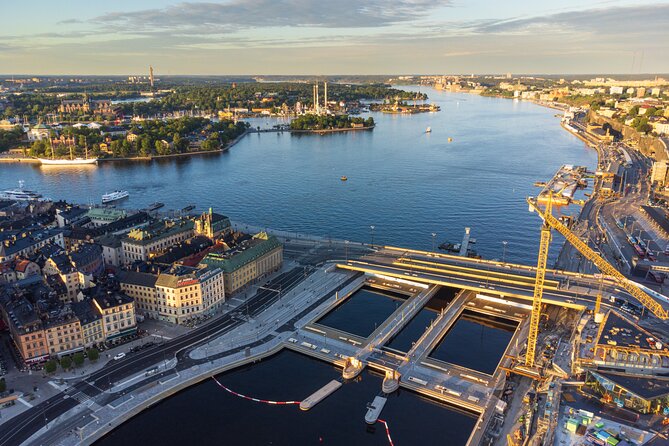
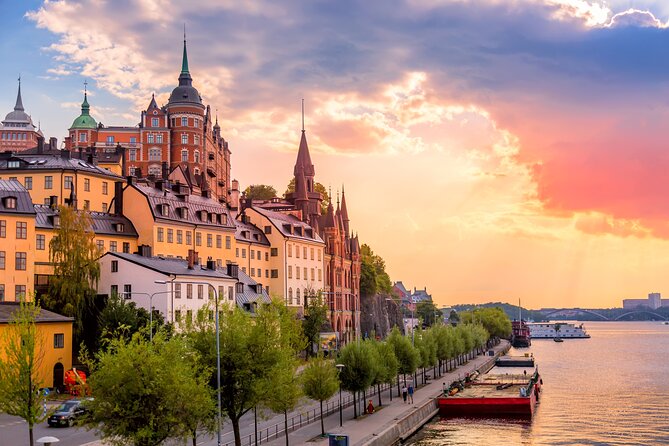
The route is broad. You begin near Södermalm, cross through Slussen, enter Gamla Stan, and continue past churches, palace buildings, government offices, and waterfront districts. You finish at Stockholm City Hall, a useful location for continuing your sightseeing.
The walk is especially well suited to your first day or two in Stockholm. You can get your bearings, note restaurants and museums to return to, and learn which places deserve a longer visit. Several people have also used the guide’s advice for later transport and meals, which adds practical value to the three-hour route.
The tour is offered in English, with Swedish also available from the guides. Kenneth is a Stockholm local who often brings in memories of growing up in the city. Rachel is also praised for making the walk feel personal, stopping for photographs, and adjusting explanations to individual interests, including architecture.
A few more Stockholm trips to weigh up
- Stockholm: Ghost Walk and Historical Tour
★ 4.7 · 2,206 reviews - Walking Tour of Stockholm Old Town
★ 5.0 · 1,175 reviews - The Original Stockholm Ghost Walk and Historical Tour – Gamla Stan
★ 4.5 · 1,165 reviews
Starting at Södermalmstorg and Slussen
The official meeting information needs a little attention. The route description places the meeting point at the east entrance of the Stockholm City Museum, while the meeting-point details give Götgatan 1, 116 46 Stockholm. Before setting out, check the detailed email sent by Adding:tours, since it is meant to explain exactly where to go and how to reach the guide.
The first stop at Södermalmstorg is brief, just five minutes, but it puts you on the edge of one of Stockholm’s most useful transitions. Södermalm feels different from the medieval lanes ahead, and the opening helps you understand how the city’s islands fit together.
At Slussen, the guide explains the lock that gives the area its name and its role in Stockholm’s development. This is not just a crossing point. It is a major connection between Lake Mälaren and the Baltic, and the guide also discusses the long-running Slussen redevelopment project, listed as covering 2016 to 2025.
The Slussen stop is short, so do not expect a full architectural tour of the project. Its value is the explanation of why this complicated traffic and water junction matters. You then make your way at a relaxed pace toward Gamla Stan.
Järntorget and the working city behind the postcard
Järntorget, or Iron Square, offers a useful correction to the idea that Gamla Stan is only about palaces and churches. Its name reflects earlier trade and iron processing, while later buildings connect the square with banking, commerce, and public life.
You spend about ten minutes here, looking at notable buildings and hearing about cultural figures, including an important Swedish poet. This is a good place to ask questions, especially if you want help connecting the city’s literary life with its political and commercial past.
The square can be busy, and the stop is more about stories than extended viewing time. If you want detailed architectural analysis of every facade, the tour will move too quickly. For a first orientation, though, it gives you a useful sense of how ordinary business helped shape the Old Town.
Mårten Trotzigs Gränd, 36 steps in a narrow lane
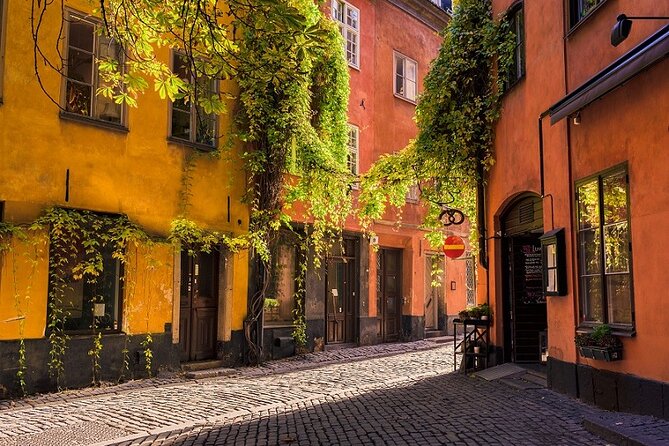
Mårten Trotzigs Gränd is one of the route’s most memorable physical details. The passage narrows dramatically and includes 36 steps. Its story reaches back to a German merchant who bought the alley in the 16th century, followed by a later period of revival and preservation.
This is a fine example of why a guide helps in Gamla Stan. Without context, the lane is a quick photograph. With context, you see how property, trade, neglect, and preservation shaped the oldest parts of Stockholm.
The drawback is simple: the passage is narrow and stepped. It may be awkward if you have balance problems or find uneven surfaces difficult. The tour information asks for moderate physical fitness, and this is one of the places where that advice matters. Good shoes are more important than stylish shoes here.
Same city, a completely different kind of day:
- Stockholm: City Archipelago Sightseeing Cruise with Guide
★ 4.3 · 10,798 reviews - Stockholm: Skansen Open-Air Museum Admission Ticket
★ 4.5 · 3,427 reviews - Stockholm: Archipelago Boat Tour
★ 4.4 · 3,110 reviews - Stockholm: Highlights Boat Tour
★ 4.3 · 2,542 reviews
German Church, Finnish Church, and a Viking-era link
S:ta Gertrud, usually called the German Church, opens a window onto Stockholm’s German-speaking community. King Johan III granted German residents permission to form their own congregation in 1571. By 1607, they had exclusive use of a church space that had earlier been shared with the Finnish-speaking parish.
The guide spends about ten minutes explaining this development. It is a useful reminder that Stockholm has long been shaped by people arriving from elsewhere, bringing language, trade, religion, and institutions with them.
Nearby, the Finnish Church has its own unusual beginning. Its building began as a royal tennis court before becoming a place of worship. The church does not have the same scale as the German Church, but its story is just as helpful for understanding how communities adapted buildings to meet their needs.
The Rune Stone U 53 provides another sharp change of subject. This stone links present-day Stockholm with Sweden’s Viking past. You will not spend long at it, but the stop adds an ancient voice to a route otherwise filled with later churches, palaces, and government buildings.
Stortorget and the Stockholm Bloodbath
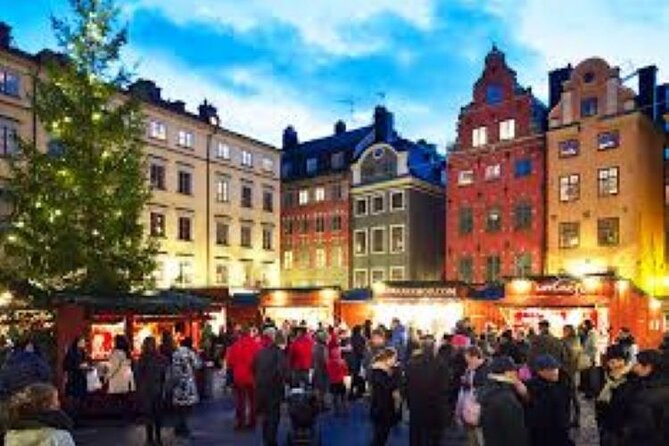
Stortorget is the oldest square in Stockholm and the central point around which Gamla Stan developed. It is also where the guide can bring together several of the city’s biggest themes: commerce, monarchy, architecture, violence, and popular culture.
The square was the site of the Stockholm Bloodbath from November 7 to 9, 1520. That event helps explain the intense political conflict between Sweden and Denmark during the era of the Kalmar Union. The guide’s job here is not simply to list dates, but to show how a compact square became part of a national turning point.
Look around the Stock Exchange Building, Runestone House, Schantzska House, Seyfridtzska House, Scharenbergsska House, and Grillska House. You also hear about Stortorgs Källaren, a restaurant with a story involving a cannonball, and the fountain where a famous 1976 photograph of ABBA was taken.
The Nobel Prize Museum occupies the historic Stock Exchange Building and opened in 2001, marking the 100th anniversary of the Nobel Prize. The museum is not entered on this walk, so plan a separate visit if its exhibitions interest you. The outside explanation still helps you understand why this square remains tied to both Sweden’s older civic life and its modern international reputation.
St. George, the Dragon, and Stockholm’s symbols
The St. George and the Dragon sculpture in Stockholm Cathedral is one of the route’s strongest links between art and political memory. The original wooden sculpture was placed in the cathedral in 1489. It is widely connected with Sten Sture the Elder and Sweden’s victory over Christian I at the Battle of Brunkeberg in 1471.
The dragon story is familiar across Europe, but here it carries a specifically Swedish meaning. Saint George represents courage and victory, while the dragon becomes a symbol of the opposing force. The guide explains how the sculpture helped turn a military victory into a lasting public image.
The walk does not include cathedral admission, so you should not assume you will see every interior detail. You do, however, get the background needed to decide if returning for an inside visit is worthwhile.
A much smaller work of art follows: Järnpojken, or the Iron Boy. This tiny sculpture has a surprisingly warm place in Stockholm’s daily life. People leave coins, pat its head, and knit small winter garments for it. The stop takes only five minutes, but it adds a human scale to the grand stories of kings and battles.
The Royal Palace from the outside
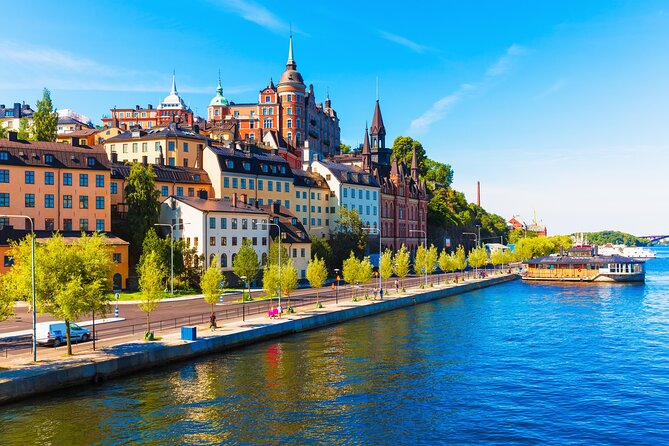
The Royal Palace receives about fifteen minutes, enough for a focused introduction to its history and exterior setting. The palace grew from the medieval Tre Kronor castle complex, and the guide explains how the older royal site connects to the building you see today.
Inside are royal apartments, reception rooms, banquet halls, the Hall of State, the Royal Chapel, and Gustav III’s Museum of Antiquities. None of that admission is included, so consider this stop a preview rather than a palace visit.
The guide also introduces statues of Karl XIV Johan, Gustav III, Olaus Petri, also known as Master Olof, and Kristina Gyllenstjerna. These figures help place the palace within Swedish religious, political, and royal history.
One useful modern detail is that the current royal family moved to Drottningholm Palace in 1981. The Stockholm palace remains a working ceremonial site, but Drottningholm became the family’s private residence. If you plan to visit Drottningholm later, this explanation gives you a helpful comparison between the two royal settings.
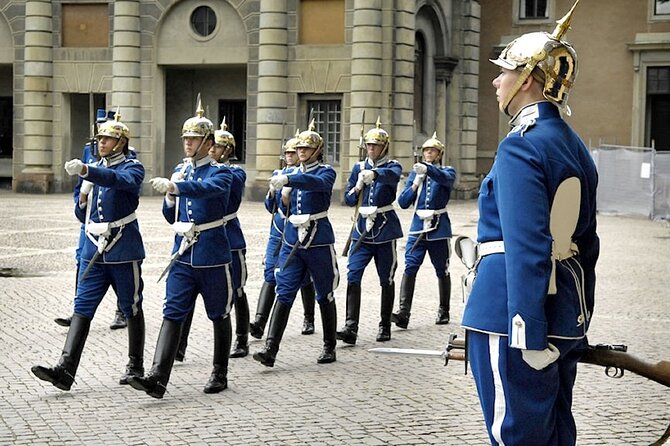
The palace area is also a possible place to see the changing of the guard, depending on timing. One guide-led walk included that sight, but it should not be treated as guaranteed. The schedule and ceremony can vary.
Riddarholmen and the House of Nobility
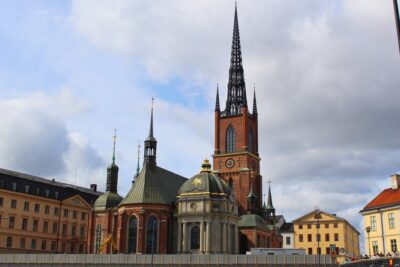
Riddarholmen changes the mood again. The island began its transformation in the 1200s with the Grey Friars Monastery. After the Tre Kronor castle fire in 1697, government offices and courts gradually moved onto the island, giving it a strong legal and administrative role.
The guide discusses Riddarholm Church, the monastery connection, and a statue of poet Evert Taube. This is a particularly good section for understanding how Stockholm’s old religious buildings later became part of the state’s civic machinery.
Next comes Riddarhuset, the House of Nobility. Its palace was built between 1641 and 1674 and remains linked to Sweden’s knighthood and noble families. The exterior offers a clear look at the power and taste of the 17th-century elite.
Bonde Palace provides the judicial counterpart. It is home to Sweden’s Supreme Court, so the building connects the old aristocratic city with modern legal institutions. The route does not enter either building, but the guide gives you enough context to see why this small district matters.
Parliament, Rosenbad, and modern Sweden
The route continues to the Parliament Building, Riksdagshuset, built between 1895 and 1904. The original complex included the national bank in its western section. When Sweden moved from a bicameral parliament to a unicameral system in 1971, the former bank area was altered to create the new plenary chamber.
This is one of the best stops for understanding that Swedish history is not confined to medieval squares. The building still serves the Riksdag, and the guide also points out the sculpture The Homeless Fox. Greta Thunberg is another modern figure associated with the area.
Rosenbad, the seat of the Swedish government, follows. It represents the working machinery of Swedish democracy, while the Royal Palace represents monarchy and ceremony. Seeing both in the same walk gives you a clearer picture of how Sweden’s institutions share the capital.
The official residence of the prime minister has been Sergelska Palatset since 1995. These details may sound dry on paper, but they become more useful when you are standing among the buildings where national decisions are made. The guide can answer questions as they arise, which several guests valued because the facts remain tied to the place in front of you.
Finishing at Stockholm City Hall
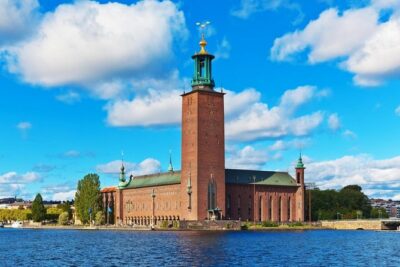
The walk ends at Stockholm City Hall, one of Stockholm’s most recognizable buildings. Its design blends Italian Renaissance and Nordic Gothic influences with the National Romantic style. The Blue Hall and Golden Hall are famous for the Nobel Banquet, though this walking tour does not include entry.
Ending here works well. City Hall gives the route a strong visual finish and places you near water, public transport, and further sightseeing. The guide can also help you find your next destination, work out a tram or other public transport connection, suggest a restaurant, or point you toward a museum.
This after-tour help is a real benefit if Stockholm is your first stop in Sweden. One guide even helped a couple recover from being dropped at the wrong meeting point, and several guests received advice about food, museums, and onward routes. That kind of help is not a formal sightseeing stop, but it can save time and prevent a first-day muddle.
How the guiding style affects the experience
The strongest feature here is the human delivery. Kenneth is described as warm, funny, and easy to question while walking. His approach combines old events, present-day Stockholm, cultural figures, and personal memories from growing up in the city.
Rachel brings a similar local focus, with particular attention to architecture, photographs, and practical recommendations. The guides do not appear to rely only on a fixed speech. They have adjusted the route or emphasis around interests such as buildings, food, and transport.
That does not mean every departure will become a private tour. Some past bookings ended up with only one or two people, but the stated maximum is 100. If personal conversation is central to your decision, ask about the expected group size before you pay.
The English is intended to be accessible rather than academic. That suits a first look at Stockholm, especially if you want to ask questions as you go. You should choose a specialist museum tour instead if you want highly detailed coverage of one subject.
Price, practical details, and who should book
The $66.52 price makes sense for you if you value a local guide, a wide route, live questions, and useful advice for the rest of your stay. It is less attractive if you mainly want entry to museums or the Royal Palace, since those tickets cost extra and are not part of the three hours.
The route includes many short stops, often five to fifteen minutes, with walking between them. You should expect cobblestones and steps, and the tour asks for moderate physical fitness. Service animals are allowed, and the route is near public transportation.
Bring comfortable shoes and dress for changeable weather. The guide’s email is important because the meeting information includes detailed directions and an office telephone number for problems on the day.
You can cancel for a full refund up to 24 hours before the start time. Cancellations or changes made less than 24 hours before the start are not accepted for a refund.
This tour suits first-time visitors, history fans, architecture students, curious walkers, and anyone who wants a clear overview before choosing which museums to visit. It is also a good fit if you enjoy asking questions instead of waiting for a scheduled coffee break.
It is not the best match for someone who wants a relaxed cafe stop, extensive indoor sightseeing, or a short walk with little uneven ground. The route covers a lot, and its value comes from connecting many places rather than lingering at one.
Should you book the Classic Stockholm Small Group Walking Tour?
Book it if you want a lively first look at Stockholm with local context, especially during your first days in town. The mix of Gamla Stan lanes, Viking stonework, churches, palace stories, government buildings, and City Hall gives you a strong base for independent sightseeing.
I would book early, since the experience is often reserved well ahead of the date. Before confirming, check the exact meeting address and ask how large your group is expected to be. If you are comfortable walking on cobblestones and paying separately for any interior visits, the tour offers a useful and personable introduction to Stockholm.
FAQ
How long is the Classic Stockholm Small Group Walking Tour?
The tour lasts approximately three hours.
What language is the tour offered in?
The tour is offered in English. The guides also offer Swedish.
Where does the tour start?
The meeting details list Götgatan 1, 116 46 Stockholm, Sweden. The route information also refers to meeting at the east entrance of Stockholm City Museum, so check the pre-tour email for the exact meeting instructions.
Where does the tour end?
The tour ends at Stockholm City Hall, in a different location from the starting point.
Does the tour enter the Royal Palace or Nobel Prize Museum?
No. The attractions are not entered during the walking tour. Admission to museums and other special sites is not included.
Is transportation included?
No. Public or private transportation to the meeting point, and any transportation during or after the activity, is not included.
How large can the group be?
The stated maximum is 100 people. The experience is described as a small-group tour, but the actual group size can vary.
Can I cancel for a refund?
Yes. You can cancel at least 24 hours before the start time for a full refund. Cancellations or changes made less than 24 hours before the start time are not accepted for a refund.
Just added around Stockholm
- World War II Stockholm Old Town Walking Tour and Army Museum★ 4.6 · 4 reviews
- Stockholm: Archipelago Guided Boat & Walking Tour of Vaxholm★ 3.1 · 23 reviews
- Stockholm: Underground Metro Art Ride with a Local Guide★ 4.6 · 39 reviews
- Vaxholm & Stockholm Archipelago: Guided Excursion, Day Trip★ 4.8 · 41 reviews
- Wolf and Wildlife Tracking in Sweden★ 5.0 · 9 reviews
- Scandinavian Art, Architecture and Design Tour in Stockholm★ 4.5 · 11 reviews
- Private Tour: Swedish History Day Trip to World Heritage Candidate Markim-Orkesta from Stockholm★ 5.0 · 8 reviews
- Walking Tour of Stockholm’s City Center★ 4.5 · 26 reviews
Walking Tours, compared.
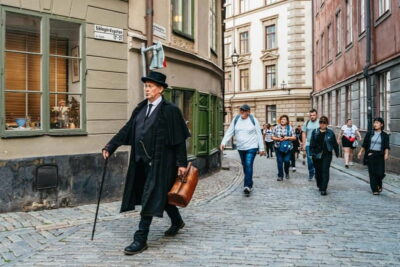
The Original Stockholm Ghost Walk and Historical Tour – Gamla Stan
Read our review →
Best of Stockholm Walking Tour-3 Hours, Small Group max 10 people
Read our review →
Old Town Guided Walking Tour (English / Deutsch)
Read our review →Browse the lists this tour appears in