
Reviewed · WALKING TOURS
Stockholm Syndrome Private Walking Tour
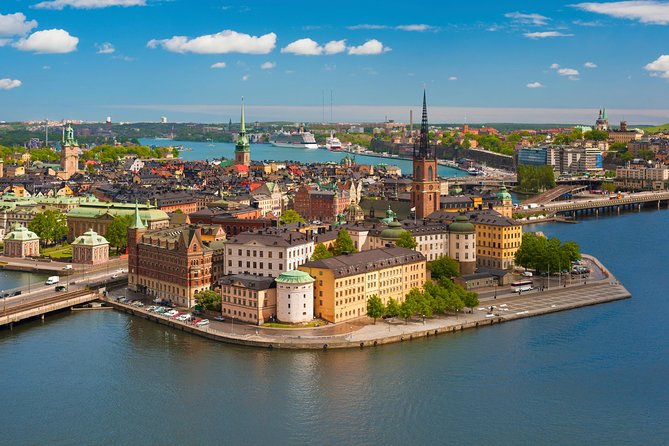
The curious name points to the tour’s first stop: Norrmalmstorg, the square linked to the 1970s bank robbery that gave the world the term Stockholm Syndrome. From there, you walk through royal Stockholm, medieval Gamla Stan, and the creative streets of Södermalm, finishing at Cornelisparken above the water.
I like the private format, which gives you room to ask questions and adjust the route to your interests. I also like the built-in fika, a simple Swedish pause with coffee or tea and a pastry, especially after several hours on cobblestones.
The main consideration is the price: at $418.80 per person, this is a serious splurge. The route is also one-way and finishes far from the starting point, so you should be ready for a long walk or agree with your guide on an earlier ending.
In This Review
- Key points at a glance
- Start at Norrmalmstorg, where a phrase was born
- Royal Stockholm in parks and public buildings
- Gamla Stan, where medieval Stockholm comes alive
- Mårten Trotzigs gränd and the turn toward Södermalm
- Götgatsbacken brings out Stockholm’s modern side
- Coffee, views, and old wooden houses
- Katarinahissen and Cornelisparken finish the walk well
- What $418.80 per person really buys
- Who should book this Stockholm walk?
- Should you book it?
- FAQ
- Where does the private walking tour begin?
- Where does the tour end?
- How long does the tour last?
- Is the tour private?
- Is food or drink included?
- Are admission fees to the Royal Palace and Stockholm Cathedral included?
Key points at a glance
- Norrmalmstorg begins the story: Learn how a Stockholm bank robbery shaped a famous psychological term.
- One private route covers three different Stockholms: See royal landmarks, medieval Gamla Stan, and the alternative side of Södermalm.
- The walk is customizable: Tell your guide what interests you, how far you want to walk, and where you would like to finish.
- Fika is included: Coffee or tea and a pastry provide a welcome break during the three-hour outing.
- The ending brings wide city views: Cornelisparken and the Södermalm heights offer a strong final look across Stockholm.
- You need moderate fitness: Expect cobblestones, hills, and a route that can finish well away from the start.
Start at Norrmalmstorg, where a phrase was born
The tour opens at Norrmalmstorg, a central town square with an unusual place in modern language. A bank robbery and hostage situation there in the early 1970s led to the term Stockholm Syndrome, making this a memorable way to begin learning about the city.
You spend about 10 minutes here, with no admission charge. The stop is not just a quick photo opportunity. It gives your guide a chance to explain how a local event became known around the world, and it sets the tone for a walk built around stories rather than a march from one monument to the next.
From there, the route moves to Nybroplan and the Royal Dramatic Theatre. Sweden’s national stage for spoken drama has connections to famous Swedish performers, including Ingmar Bergman and actors from the Skarsgård family. You only spend about five minutes here, but it adds a cultural note before the grander sights begin.
A few more Stockholm trips to weigh up
- Stockholm: Ghost Walk and Historical Tour
★ 4.7 · 2,206 reviews - Walking Tour of Stockholm Old Town
★ 5.0 · 1,175 reviews - The Original Stockholm Ghost Walk and Historical Tour – Gamla Stan
★ 4.5 · 1,165 reviews
Royal Stockholm in parks and public buildings
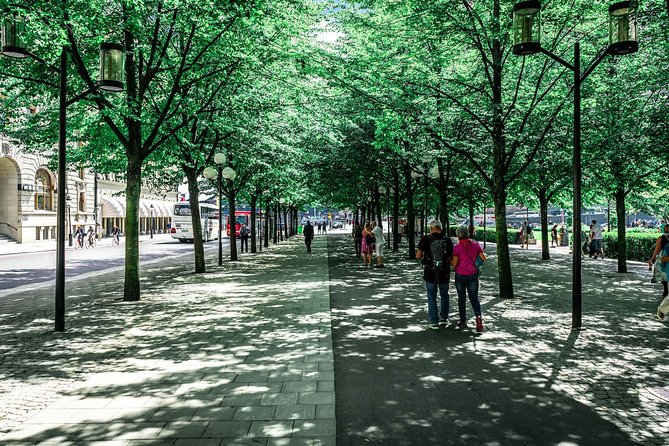
Kungsträdgården, or the King’s Garden, is one of the city’s main meeting places. Its past reaches back to the 1400s, when it served as the king’s kitchen garden, and it later became a public park in the 1700s.
This is a useful stop because Stockholm’s public life changes with the seasons. Concerts and festivals fill the park in summer, ice skating takes over in winter, and cherry blossoms make spring especially photogenic. Autumn brings changing leaves. Your 10-minute visit helps you see the park as a living part of the city, not just an open patch between attractions.
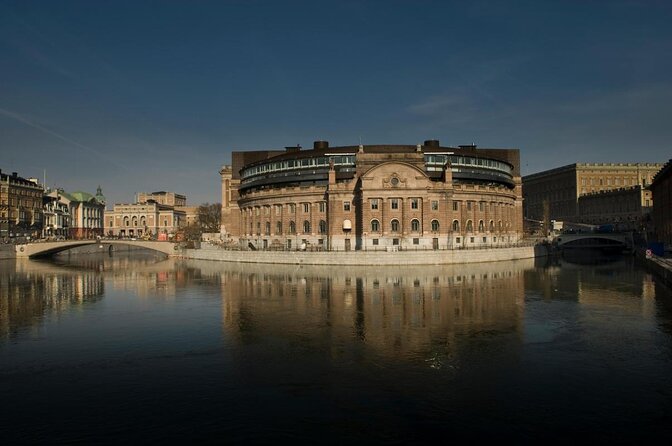
The Parliament Building follows on Helgeandsholmen, an island occupied by Sweden’s national legislature. Your guide can explain the country’s one-chamber parliament, which has 349 elected members and has operated in its current form since 1971.
The stop lasts only about five minutes, so do not expect an inside visit. Still, the building and its island setting offer a clear introduction to how modern Sweden is governed. It also provides a useful contrast with the monarchy you see next.
The Royal Palace is the official residence of Sweden’s king and one of Europe’s largest royal residences. Essential parts of the monarchy’s public work take place here, so the palace remains an active institution rather than simply a preserved old building.
You spend around 10 minutes outside, and admission is not included. That matters if you want to tour the interior. I would treat this walk as an orientation, then decide with your guide if the palace deserves a separate visit later in your trip.
Gamla Stan, where medieval Stockholm comes alive
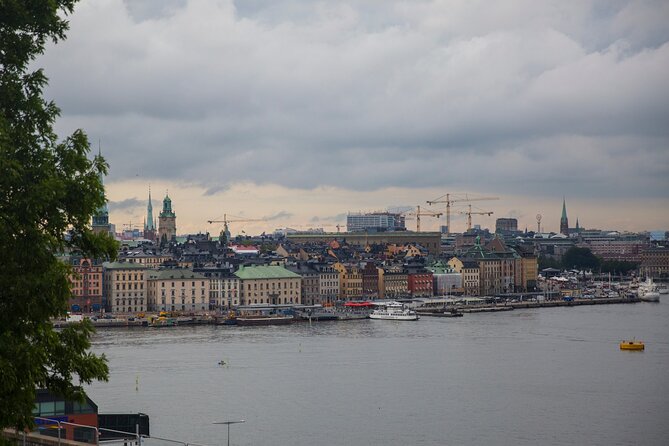
The route then reaches Gamla Stan, Stockholm’s Old Town and the historic center of the city. Narrow lanes, old buildings, and irregular streets make this part best explored on foot, though the same charm brings uneven cobblestones and slower walking.
Stortorget is the Old Town’s main square and one of the key points on the route. It was the site of Stockholm’s first town hall, and the Nobel Museum is located here for now. The square is also linked to the Stockholm Bloodbath, a violent event that your guide can place in the broader struggle between Sweden and Denmark.
This is one of the stops where a private guide earns their keep. A quick look at colorful façades tells you very little by itself. The political conflicts, royal ambitions, and Scandinavian power struggles behind the square give it much more meaning.
Stockholm Cathedral, or Storkyrkan, is another highlight. The church is associated with the wedding of King Carl XVI Gustaf and Queen Silvia, and it remains open to visitors throughout the year. There is a small entrance fee, while attending a service or entering briefly for silence or prayer is free.
The cathedral’s most notable object on this walk is the wooden statue of St. George and the Dragon, made in the 1470s. The image represents the struggle between Sweden and Denmark, with St. George linked to Sweden and the dragon to Denmark. A five-minute exterior stop is listed, so ask your guide if you want time to see the interior and statue properly.
The nearby Iron Boy statue is much smaller in scale but easy to remember. Officially called Iron Boy, it is also known as the Boy Looking at the Moon. The sculpture reflects artist Liss Eriksson’s childhood memory of sitting on his bed and looking through a window at the moon.
You then see another statue of St. George and the Dragon, this one interpreted through the conflict between King Christian I of the Kalmar Union and Sten Sture the Elder, the Swedish head of state. The two St. George references can blur together, so this is a good place to ask your guide to explain the difference.
Mårten Trotzigs gränd and the turn toward Södermalm
Mårten Trotzigs gränd is one of Gamla Stan’s most entertaining stops. At its narrowest, the alley is only about 90 centimeters wide. It is often called the narrowest alley in Europe, but that claim is not accurate. A Prague alley is narrower at 60 centimeters, and other European lanes may beat it too.
That correction is typical of what makes a good walking tour useful: you get the fun fact without being asked to accept an inflated one. The alley takes about five minutes, but it gives you a strong sense of how tightly built the Old Town can be.
The route then crosses toward Slussen, whose name means the lock. Stockholm sits between Lake Mälaren and the Baltic Sea, and the lake is roughly 70 centimeters higher than the sea. The lock manages that difference in water level and helps explain why this part of the city matters beyond its roads and construction.
Slussen is also the point where the atmosphere begins to shift. The grand royal center and medieval Old Town give way to Södermalm, a district known here for shopping, cafés, nightlife, old houses, and a less formal city mood.
Same city, a completely different kind of day:
- Stockholm: City Archipelago Sightseeing Cruise with Guide
★ 4.3 · 10,798 reviews - Stockholm: Skansen Open-Air Museum Admission Ticket
★ 4.5 · 3,427 reviews - Stockholm: Archipelago Boat Tour
★ 4.4 · 3,110 reviews - Stockholm: Highlights Boat Tour
★ 4.3 · 2,542 reviews
Götgatsbacken brings out Stockholm’s modern side
Götgatsbacken is a pedestrian section of Götgatan and a good place to see everyday Stockholm rather than only its official monuments. You pass modern Swedish brands such as H&M, Filippa K, and Cheap Monday, along with vintage and secondhand shops.
The street also has bars and pubs with a relaxed feel. The stop is short, about five minutes, but the area offers a useful change of pace. If your interests lean toward shopping or local street life, tell your guide early, since the private format may allow more attention here.
Södermalm is also the setting for several literary and musical references. Fiskargatan is tied to Stieg Larsson’s Millennium Trilogy, where Lisbeth Salander is pictured living in a luxury apartment. The stop takes about five minutes and will mean more to you if you know the books, but it still shows how Stockholm’s real streets have entered popular fiction.
At Katarina Church, you see a part of the district connected to notable Swedes. Anna Lindh, the assassinated foreign minister, is buried in the surrounding cemetery, along with author Per Anders Fogelström and troubadour Cornelis Vreeswijk.
The church itself has burned and been rebuilt over time, but the supplied tour details focus on the cemetery and its people. As with several stops, you should think of this as a guided introduction rather than a full church visit.
Coffee, views, and old wooden houses
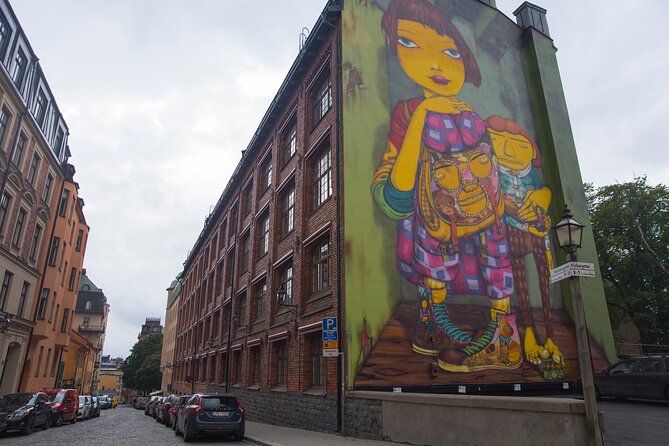
The route’s fika break is included in the price. You receive coffee or tea and a pastry, giving you a chance to sit, ask questions, and recover from the walk. Fika is not a grand meal, but it is an important part of Swedish daily life, and it gives the tour a welcome human pause.
The exact café location is not specified, so the timing may depend on the route, weather, and your guide’s choices. If you have food preferences or a strong interest in stopping at a particular place, discuss that at the start.
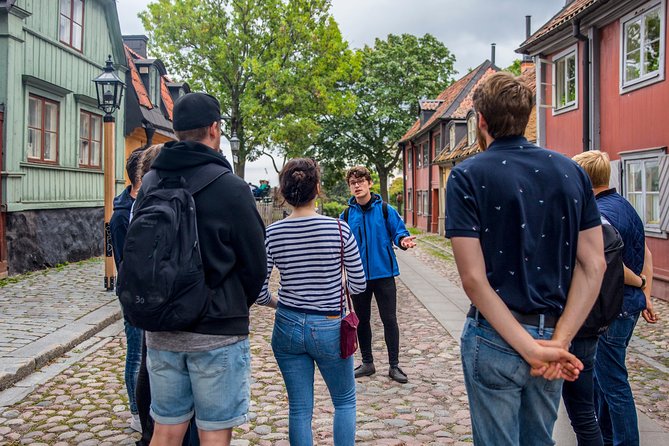
Master Mikaels Gata offers a quieter view of Södermalm. The street has colorful wooden houses and takes its name from Mikael Reissuer, who served as Stockholm’s executioner for 15 years in the 1600s.
Many of the wooden houses are cared for by AB Stadsholmen, a government-owned property company responsible for buildings with cultural importance. This stop helps you notice a form of Stockholm architecture that can be missed if you stay only on the main streets.
Mosebacke Torg adds another neighborhood scene. The square is home to Södra Teatern, and in summer it hosts one of Stockholm’s popular beer gardens. A sculpture called The Sisters is also located here. You spend about five minutes, enough to see the setting and hear why it matters.
Katarinahissen and Cornelisparken finish the walk well
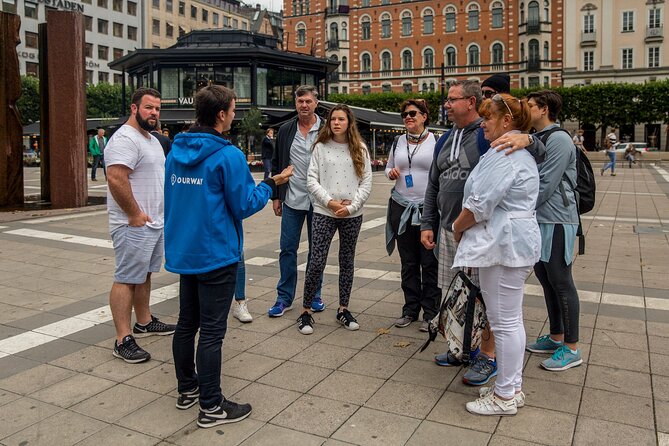
Katarinahissen, the Katarina Elevator, once helped people avoid climbing the steep side of Södermalm. Today it is mainly valued as a viewpoint, and the tour allows about 10 minutes for photos and city views.
The elevator itself may not be the main point of the stop. The value is the height, which lets you understand Stockholm as a city spread across islands and waterways. Bring a camera, but also take a moment to look beyond the obvious postcard angle.
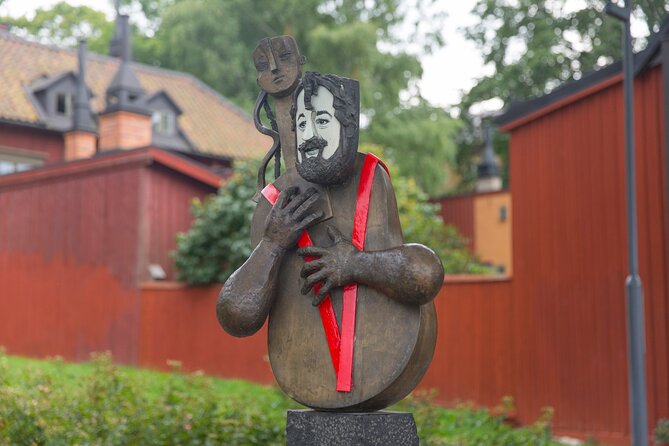
The final stop is Cornelisparken, a park dedicated to Cornelis Vreeswijk, often compared with Bob Dylan because of his importance as a troubadour. The park opened in 2000 and has broad views over Stockholm.
Ending here gives the walk a satisfying shape. You begin with a modern event in central Stockholm, pass through royal and medieval landmarks, then reach the streets, viewpoints, and cultural figures of Södermalm. From Cornelisparken, you are free to continue exploring on your own.
The ending is also the tour’s clearest practical drawback. Cornelisparken is far from Norrmalmstorg, and one person specifically found the return walk long and tiring. Ask your guide at the beginning how far you will walk and agree on a stopping point if you do not want to complete the full route.
What $418.80 per person really buys
At $418.80 per person, the tour is expensive for a three-hour city walk. You are not paying for entry to major attractions, and the palace and cathedral admission fees are separate. You are paying for a private guide, a route that can respond to your interests, and the chance to ask questions without a larger group setting the pace.
The value is strongest for first-time visitors who want a fast but thoughtful orientation. One person used it early in a Stockholm stay to decide which places deserved a longer return visit. That is a smart way to use the tour, since the walk shows you many areas without pretending that five or 10 minutes at a stop replaces a proper visit.
Group discounts may improve the price for larger parties, though the exact discount is not given. Because the activity is private, the per-person cost makes more sense when divided among several people in your own group. Solo visitors should compare the price carefully with a shared walking tour.
The operator receives a five-star rating from eight reviews, with particular praise for the amount of history covered, the guide’s recommendations, and the clear overview of Stockholm. Katrin is specifically named as an excellent guide, so you can request her if availability allows, but a particular guide is not guaranteed.
Who should book this Stockholm walk?
I would choose this tour if you want a personal introduction to Stockholm and have enough time afterward to revisit the places that catch your attention. It suits couples, families, or small groups who value private conversation and do not want to follow a fixed large-group route.
It also works well for people interested in several subjects at once. The walk connects the Stockholm Syndrome story, Swedish politics, royal life, medieval conflict, Viking history, literature, music, architecture, and modern neighborhood life.
You should think twice if you dislike long walks, steep streets, or cobblestones. The route takes about three hours, operates in all weather, and requires moderate physical fitness. Comfortable clothing and suitable shoes are essential.
The walk is available in English and includes a mobile ticket. Service animals are allowed, and the meeting point is near public transportation. Free cancellation is available if you cancel at least 24 hours before the local start time, but changes or cancellations inside that window are not accepted.
Should you book it?
Book this private walk if you want a story-led first look at Stockholm, especially at the beginning of your stay. The mix is unusually broad: Norrmalmstorg and the Royal Palace cover national symbols, Gamla Stan supplies medieval streets and political drama, and Södermalm adds cafés, old wooden houses, literature, music, and views.
Skip it if $418.80 per person feels too high for an orientation walk or if you prefer to spend several hours inside museums and historic buildings. If you do book, wear good shoes, ask about the full distance before setting out, mention your interests at Norrmalmstorg, and decide in advance whether you want to finish at Cornelisparken or end closer to the center.
FAQ
Where does the private walking tour begin?
The tour begins at Norrmalmstorg in central Stockholm, Sweden.
Where does the tour end?
The planned ending is Cornelisparken at 116 20 Stockholm, in Södermalm. Depending on the weather, your interests, and how far you want to walk, you can ask your guide to agree on an earlier ending point.
How long does the tour last?
The walking tour lasts approximately three hours.
Is the tour private?
Yes. Only your group participates in the activity, and the route can be adjusted around your interests, preferred distance, and possible destinations.
Is food or drink included?
Yes. The tour includes a traditional fika with coffee or tea and a pastry.
Are admission fees to the Royal Palace and Stockholm Cathedral included?
No. Admission to both the Royal Palace and Stockholm Cathedral is not included. The tour mainly provides exterior visits at these stops, and the cathedral has a small entrance fee for visitors.
Just added around Stockholm
- World War II Stockholm Old Town Walking Tour and Army Museum★ 4.6 · 4 reviews
- Stockholm: Archipelago Guided Boat & Walking Tour of Vaxholm★ 3.1 · 23 reviews
- Stockholm: Underground Metro Art Ride with a Local Guide★ 4.6 · 39 reviews
- Vaxholm & Stockholm Archipelago: Guided Excursion, Day Trip★ 4.8 · 41 reviews
- Wolf and Wildlife Tracking in Sweden★ 5.0 · 9 reviews
- Scandinavian Art, Architecture and Design Tour in Stockholm★ 4.5 · 11 reviews
- Private Tour: Swedish History Day Trip to World Heritage Candidate Markim-Orkesta from Stockholm★ 5.0 · 8 reviews
- Walking Tour of Stockholm’s City Center★ 4.5 · 26 reviews
Walking Tours, compared.
The Original Stockholm Ghost Walk and Historical Tour – Gamla Stan
Read our review →
Best of Stockholm Walking Tour-3 Hours, Small Group max 10 people
Read our review →
Old Town Guided Walking Tour (English / Deutsch)
Read our review →Browse the lists this tour appears in