
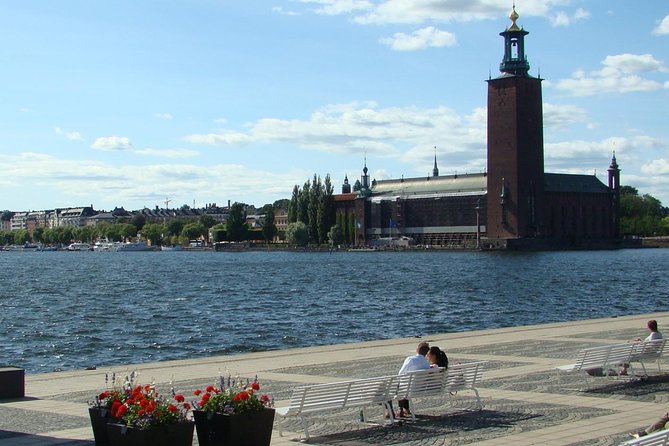
Reviewed · WALKING TOURS
The Story of Stockholm and Sweden in Three Chapters, a Small Group Walking Tour
Stockholm’s story comes into focus on this compact walk through Riddarholmen and Gamla Stan. You move from the city’s first written mention in 1252 to Gustav Vasa, Sweden’s warrior kings, parliamentary reform, two centuries of peace, and the modern companies that made Sweden famous around the world.
I like two things right away: the small maximum of 10 people, which should make it easier to hear and ask questions, and the clear three-chapter structure. I also like the ending at Stortorget, close to the Royal Palace and the changing of the guard. The main consideration is pace. Two hours covers a lot, so this is a brisk introduction rather than a slow look at every building.
In This Review
- Key points at a glance
- Why this short walk works for Stockholm
- Starting near Gamla Stan Metro station
- Chapter One: Riddarholmen and Stockholm’s first written record
- Chapter Two: Gustav Vasa, nobles, and the road to parliament
- Chapter Three: War, peace, and the Swedish model
- Stortorget and the practical finish
- Group size, pace, and value at $61.28
- Who should book this Stockholm walk?
- Should you book it?
- FAQ
- How long does the walking tour last?
- What language is the tour offered in?
- How many people can join the group?
- Where does the tour start?
- Where does the tour end?
- Is cancellation available?
Key points at a glance
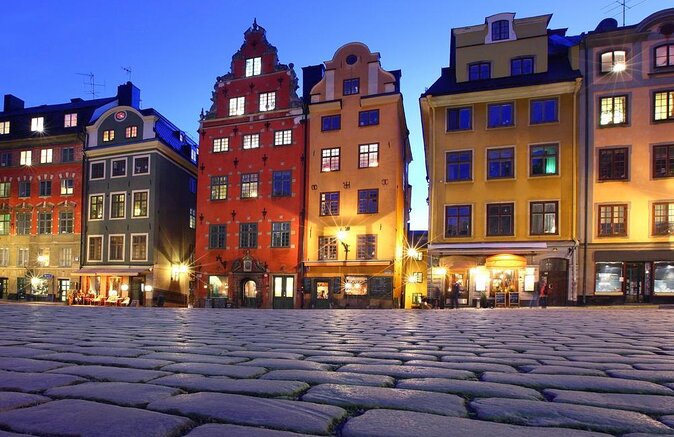
- Three clear chapters: Follow Sweden from early settlement and medieval Stockholm through empire, political reform, and the modern welfare state.
- A walk through the city’s historic core: See Riddarholmen, Riddarhuset, the Parliament Building, the Royal Palace, and Stortorget.
- Small group of no more than 10: The limited size suits anyone who wants a more personal walk than a large city tour.
- History tied to visible places: Meet Birger Jarl by his statue, see Gustav Vasa outside Riddarhuset, and hear about Karl XII near the palace.
- Useful modern context: The final chapter connects Sweden’s natural resources, inventions, entrepreneurs, Spotify, and IKEA.
- Good timing for the palace: The walk finishes near the Royal Palace, with a chance to see the changing of the guard when the schedule allows.
Why this short walk works for Stockholm
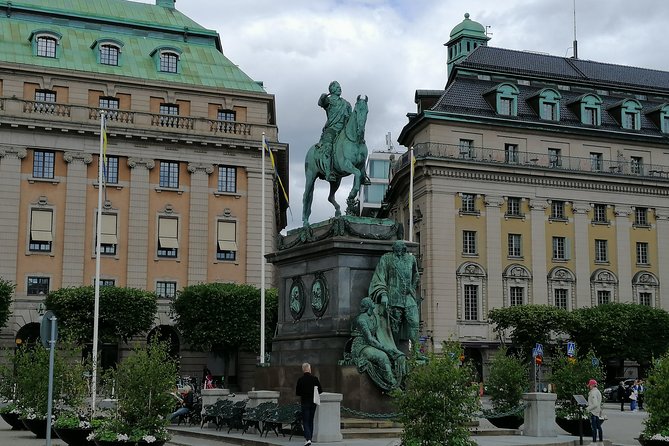
Stockholm can feel easy to understand at street level: islands, bridges, grand buildings, narrow lanes, and water everywhere. The harder part is knowing how those pieces fit together. This tour gives you a simple framework by dividing Swedish history into three chapters.
The first chapter begins with the land itself and the earliest settlement of the islands. The second moves into the formation of modern Sweden under Gustav Vasa and the country’s time as a major Baltic power. The third explains the retreat from empire, the rise of parliamentary government, industrial growth, and modern Swedish business.
I find this approach useful because the tour does not treat history as a list of kings. It connects political changes to the places around you. Riddarholmen becomes the setting for Stockholm’s beginnings. Riddarhuset introduces the noble class and Gustav Vasa. The Parliament Building opens the subject of voting rights and government. The Royal Palace brings in war, diplomacy, art, and the end of Sweden’s great-power ambitions.
At $61.28 per person, this is not the cheapest way to walk around Gamla Stan. Still, the price can make sense if you want a focused explanation rather than simply following a map between landmarks. The group limit of 10 is important here. You are paying for a guide’s time, a planned route, and a chance to ask questions without competing with a crowd.
A few more Stockholm trips to weigh up
- Stockholm: Ghost Walk and Historical Tour
★ 4.7 · 2,206 reviews - Walking Tour of Stockholm Old Town
★ 5.0 · 1,175 reviews - The Original Stockholm Ghost Walk and Historical Tour – Gamla Stan
★ 4.5 · 1,165 reviews
Starting near Gamla Stan Metro station
The tour begins at 10:00 a.m. The directions identify Munkbrogatan 8 as the meeting point and also describe the start as inside or below Gamla Stan Metro station, in front of the Pressbyrån kiosk. Those details point to the same general area, but I would check your booking confirmation carefully before setting out, especially if you are unfamiliar with Stockholm’s underground passages.
Starting near the metro is practical. You do not need to cross the city first, and Gamla Stan is well served by public transport. The tour is offered in English and uses a mobile ticket, so keep your confirmation easy to access on your phone.
You should wear comfortable shoes. The route includes several stops on foot, and the Old Town has narrow streets and older paving. A moderate level of fitness is requested, but the walk lasts about two hours, not half a day. I would still avoid carrying a large suitcase or planning this as a stop between tight transport connections.
Chapter One: Riddarholmen and Stockholm’s first written record
The opening stop is at a historical marker on Riddarholmen. Here the guide begins with the Ice Age, the first settlement of the islands, and the early story of Stockholm. That may sound broad for a walking tour, but it gives you a useful sense of time before the discussion turns to medieval Sweden.
The route then continues outside Riddarholmen Church, where a statue represents Birger Jarl, the figure traditionally linked with Stockholm’s founding. The key date is 1252, the first year that Stockholm appears in a surviving written document. The guide explains Birger Jarl’s role and the importance of that record.
This part is short, with about 15 minutes at the first stop and 10 minutes at the second. That timing tells you what to expect: a lively introduction, not an extended archaeological lecture. I like the choice of Riddarholmen because it gives the story a physical anchor. You are not just hearing that Stockholm began as a settlement and grew into a capital. You are standing on one of the islands at the heart of that change.
The itinerary allows a walk around the area and visits to open parts of the palace. Because the stops are described as free, do not expect a separate museum visit during this section. The value is in the guide’s explanation and in seeing how closely the oldest parts of Stockholm sit together.
Chapter Two: Gustav Vasa, nobles, and the road to parliament
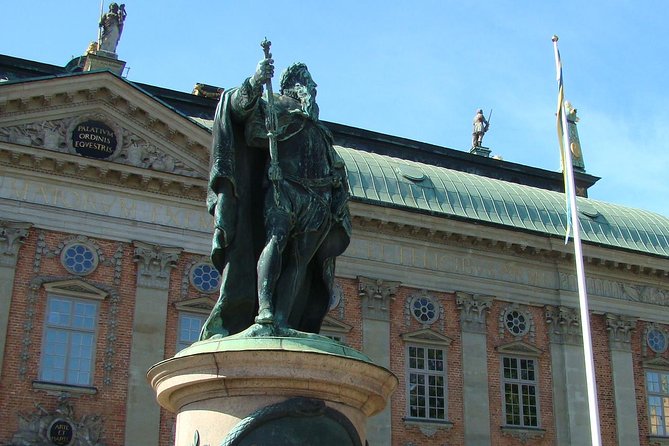
The second chapter starts outside Riddarhuset, the House of Nobility. A statue of Gustav Vasa provides the focus. Gustav marched into Stockholm in 1523 after the Stockholm Bloodbath, when his father and many other noblemen were killed. He led an uprising against the southern power controlling Sweden, and his victory helped establish Sweden as a sovereign state.
The guide also covers Gustav Vasa’s religious reforms. Sweden changed from Roman Catholicism to Lutheran Protestantism during his reign. That is a major shift in Swedish history, and it is helpful to hear it beside a building connected with the country’s political elite.
The stop lasts about 10 minutes. That is enough to set up the main idea, though you may want to explore more later if this period interests you. The tour is designed to keep moving, and the guide has several centuries still to cover.
At Vasabron, the story turns to Gustav Vasa’s heirs and heiresses. His grandson, Gustav II Adolf, is presented as the greatest of Sweden’s warrior kings. During his reign, Swedish possessions spread around the Baltic Sea, turning much of it into something close to an inland sea surrounded by Swedish territory.
This is a useful point in the walk because Stockholm’s grand political buildings make more sense when you understand Sweden’s former power. You also get a reminder that the peaceful, orderly Sweden familiar today once pursued an aggressive role in northern Europe.
The next stop is the Parliament Building, or Riksdagshuset. Here the guide explains the old Riksdag of the Estates, in which nobles, clergy, burghers, and peasants met separately before speaking with the king. Until 1866, this institution ranked as the highest authority in Sweden next to the monarch.
The political story then moves to the two-chamber parliament created in 1866 and the long struggle for equal voting rights. General suffrage arrived in 1921 after years of work by liberals and socialists. I consider this one of the strongest parts of the tour because it keeps Swedish history from becoming a parade of royal names. It shows how ordinary citizens slowly gained a greater role in government.
Same city, a completely different kind of day:
- Stockholm: City Archipelago Sightseeing Cruise with Guide
★ 4.3 · 10,798 reviews - Stockholm: Skansen Open-Air Museum Admission Ticket
★ 4.5 · 3,427 reviews - Stockholm: Archipelago Boat Tour
★ 4.4 · 3,110 reviews - Stockholm: Highlights Boat Tour
★ 4.3 · 2,542 reviews
Chapter Three: War, peace, and the Swedish model
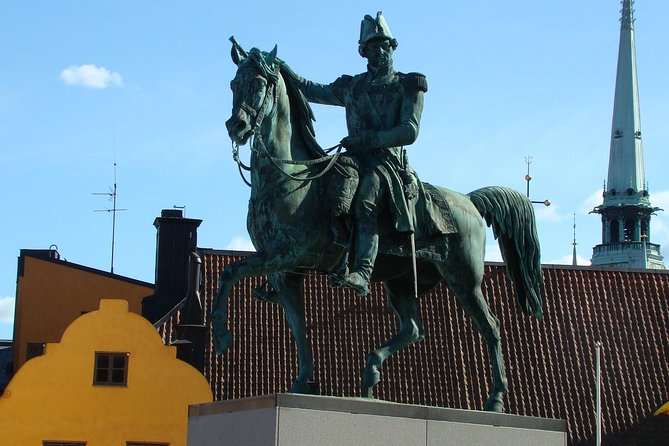
The third chapter begins at Lejonbacken, on the north side of the Royal Palace. Here the focus shifts to the end of Sweden’s great-power period. Karl XII, the last of the warrior kings, is represented by a statue pointing east toward Russia.
Peter the Great of Russia ended Sweden’s ambitions in northern Europe. Karl XII and his Carolean army won early victories, but the defeat at Poltava in 1709 marked a decisive turn. You can use the statue as a visual cue while the guide explains how military success gave way to a much smaller political role.
The subject then moves into the Age of Enlightenment, with its growing interest in science and the arts. Gustav III is introduced as an enlightened despot who supported theatre and made contributions in cultural and scientific fields. Again, the stop is brief, about 10 minutes, so the guide can only sketch the period. That is fine if you want a broad timeline, but anyone keen on Swedish theatre or royal politics will need another visit for detail.
Below the statue of Carl XIV Johan, the tour turns toward the nineteenth century. This king, the first Bernadotte, came from France and was brought to Sweden with the hope that he might help recover territory lost to Russia. Instead, he focused on diplomacy, infrastructure, and education.
That change in priorities is central to the final chapter. Sweden did not regain its former empire through another round of wars. It built a different future through peace, education, infrastructure, natural resources, industry, and invention. The tour notes that Sweden celebrated 200 years of peace in 2014, a fact that helps explain the country’s modern identity.
The final historical section reaches the twentieth and twenty-first centuries. You hear how entrepreneurs continued Sweden’s development and how the country became associated with companies such as IKEA and Spotify. This modern link is especially useful if you are visiting Stockholm with little background in Swedish history. It connects grand palaces and old political struggles with brands you may already use or recognize.
Stortorget and the practical finish
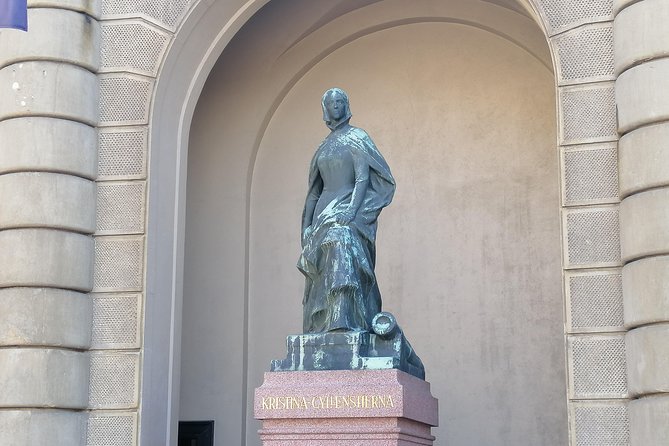
The walk ends at Stortorget, Stockholm’s best-known square in the Old Town. The Nobel Prize Museum is located here, and the guide explains the Swedish Royal Academies’ role in selecting winners in major fields of science and art.
The final stop lasts about 10 minutes. You will not receive a full museum tour, but you will finish with a clear reason to return if the Nobel prizes interest you. Stortorget is also a useful place to continue exploring Gamla Stan on your own.
The tour ends close to the Royal Palace and may line up well with the changing of the guard. During summer, the parade can include a marching or mounted procession with the Music Corps moving toward the palace’s Outer Courtyard. The schedule is not guaranteed by the tour details, so treat this as a helpful possibility rather than the main reason to book.
The ending is well planned. You can stay in the Old Town, visit the Nobel Prize Museum, walk toward the palace, or continue to another central sight without making a long journey back across Stockholm.
Group size, pace, and value at $61.28
A group capped at 10 people is one of the clearest advantages here. Small groups usually make it easier to hear the guide in public spaces and ask about details that catch your eye. This matters in Stockholm, where streets can be active and some stops are outside rather than inside quiet rooms.
The two-hour length also works well for a first morning in the city. You get an orientation without giving up the entire day. I would schedule it early in your Stockholm stay, since the route introduces many places you may want to revisit.
The tradeoff is the amount of ground covered in time. There are roughly eight stops, with most explanations lasting 10 minutes and the Old Town section lasting about 20. You will hear a broad account of Swedish history, but not receive long visits inside monuments or museums.
Admission is included along the way, and the listed stops do not carry separate admission charges. That keeps the experience simple, but you should understand the difference between included access and a full attraction visit. The main product is the guided walk and historical interpretation.
One review gives the experience a 4.6 rating from seven reviews, and the available written comment calls it fun and educational. The same person chose a shorter version because of a tight schedule and said they would have preferred the complete tour. That is useful advice: if you have only a little time, a shortened option may still help, but the full two-hour route gives the story more shape.
Who should book this Stockholm walk?
I would choose this tour if you want a history-led introduction to Stockholm and prefer learning at the places where events unfolded. It suits first-time visitors, couples, families with older children, and anyone who likes a guide to explain the connection between monarchy, war, government, and modern business.
It is also a good match if you want a small group but do not want to commit to a full-day excursion. The English-language format keeps the walk accessible to many international visitors, while the route stays within central Stockholm.
You may want something else if your priority is entering museums, touring the Royal Palace in depth, or studying one historical period closely. The walk gives you context outside major buildings. It does not replace a dedicated palace visit, Nobel Prize Museum visit, or specialist tour of Swedish military history.
The tour requires moderate physical fitness. Plan for steady walking, old streets, and outdoor stops. Because most of the content is delivered at statues, squares, bridges, and building exteriors, weather can affect your comfort. The mobile ticket is convenient, and free cancellation is available up to 24 hours before the 10:00 a.m. start time. Changes or cancellations inside that window are not accepted for a refund.
Should you book it?
Book this walk if you want Stockholm’s story to make sense quickly. Its best features are the tight route, the three-part structure, the small group, and the way it links Birger Jarl and Gustav Vasa with parliament, peace, IKEA, and Spotify.
Skip it if you mainly want interior access or a slow architectural walk. At $61.28, the value comes from the guide and the connections between the stops, not from a long list of admission tickets. For a first morning in the city, that tradeoff is reasonable, and the finish at Stortorget leaves you in a perfect position to keep exploring.
FAQ
How long does the walking tour last?
The tour lasts approximately two hours.
What language is the tour offered in?
The tour is offered in English.
How many people can join the group?
The group is capped at a maximum of 10 people.
Where does the tour start?
The meeting information gives Munkbrogatan 8 in Stockholm as the start point. The directions also specify Gamla Stan Metro station, inside or below ground, in front of the Pressbyrån kiosk. Check your confirmation for the exact meeting instructions.
Where does the tour end?
The tour ends at Stortorget in Stockholm’s Old Town, close to the Royal Palace.
Is cancellation available?
Yes. You can cancel up to 24 hours before the local start time for a full refund. Cancellations or changes made less than 24 hours before the start are not accepted for a refund.
Just added around Stockholm
- World War II Stockholm Old Town Walking Tour and Army Museum★ 4.6 · 4 reviews
- Stockholm: Archipelago Guided Boat & Walking Tour of Vaxholm★ 3.1 · 23 reviews
- Stockholm: Underground Metro Art Ride with a Local Guide★ 4.6 · 39 reviews
- Vaxholm & Stockholm Archipelago: Guided Excursion, Day Trip★ 4.8 · 41 reviews
- Scandinavian Art, Architecture and Design Tour in Stockholm★ 4.5 · 11 reviews
- Wolf and Wildlife Tracking in Sweden★ 5.0 · 9 reviews
- Private Tour: Swedish History Day Trip to World Heritage Candidate Markim-Orkesta from Stockholm★ 5.0 · 8 reviews
- Walking Tour of Stockholm’s City Center★ 4.5 · 26 reviews
Walking Tours, compared.
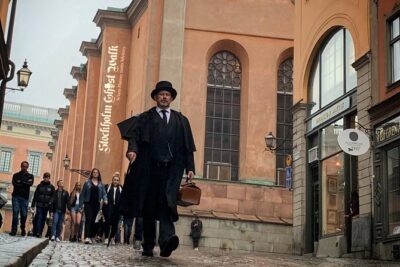
The Original Stockholm Ghost Walk and Historical Tour – Gamla Stan
Read our review →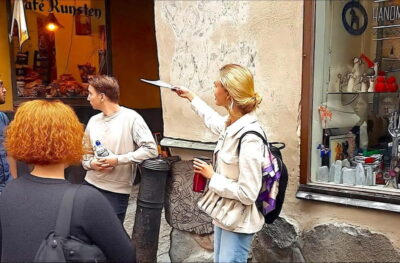
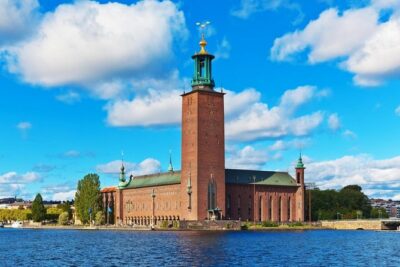
Best of Stockholm Walking Tour-3 Hours, Small Group max 10 people
Read our review →
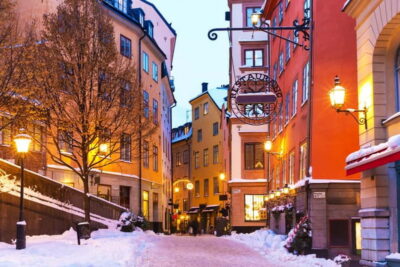
Old Town Guided Walking Tour (English / Deutsch)
Read our review →Browse the lists this tour appears in